
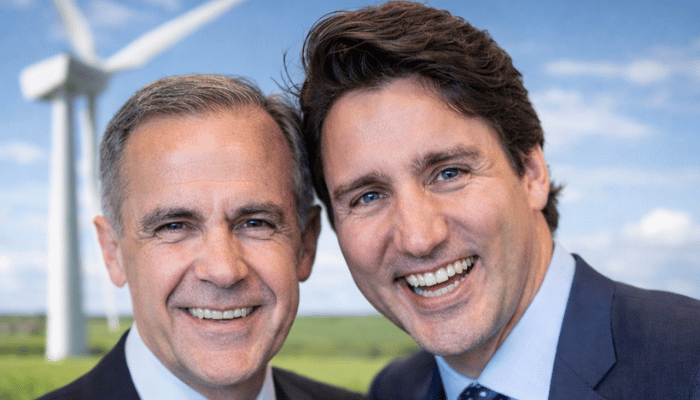
Canadian municipalities have been pushing the radical green Net Zero scam since well before Carney became Prime Minister. I wrote last year about how municipalities push the Net Zero agenda and will expand further in the coming months. But how have more senior levels of government – the ones that plow billions down to the municipal level – been involved in promoting Net Zero ideology?
Net Zero and the Canadian Governing Class
Former Prime Minister Justin Trudeau’s approach to Net Zero was overt: his first big step, in 2016, was mandating that every province have some sort of carbon tax by 2018. He mandated Net Zero by 2050 into law in 2021, including emissions caps, anti-pipeline legislation like Bill C-69, dubbed the “no more pipelines act,” and Bill C-48, the Oil Tanker Moratorium Act. At one point, even the Conservative Party of Canada’s leader, Erin O’Toole, was duped into promoting the idea of the carbon tax.
Since coming into office, Mark Carney has retained the lion’s share of Trudeau’s Net Zero madness, albeit with a more subtle bait-and-switch approach. The most conspicuous example was the scrapping of the consumer carbon tax while hiking the industrial version, so that consumers pay indirectly, through higher costs.
Carney signed an agreement in November 2025 with Alberta’s Premier Danielle Smith which theoretically offers that province a single new pipeline (which might never get built) and in exchange Alberta had to accept the federal Industrial Carbon Tax, fully commit to Net Zero by 2050, and further agree to spending a ton of money on carbon capture and storage.
So where is this pipeline? Where is it even being seriously discussed? There’s no project description, no environmental review, and no private-sector partner. It exists only as a bargaining chip – useful for selling a deal, useless for moving a single barrel of oil; in other words, still no pipeline.
Most recently, Carney replaced the federal electric vehicle (EV) mandate, which banned the sale of new gas-powered cars by 2035, with new tailpipe emissions standards demanding a 75% reduction by 2035 and 90% by 2040. Such stringent cuts constitute an EV mandate in all but name, since only EVs can realistically comply with them.
ONTARIO
Net Zero isn’t only a federal preoccupation. All of the provincial governments are complicit in the Net Zero scam. And Doug Ford’s Ontario has become the poster child for provincial Net Zero fantasies.
Though Ford came into office in 2018 pledging to fix the energy mess his Liberal predecessors had left him, wind and solar today still – today, in 2026! – comprise a larger share of Ontario’s energy grid than they did eight years ago, his so-called “conservative” government plans to double wind and solar capacity over the next decade. The Ontario government is already spending billions of dollars per year of taxpayer money to subsidize electricity rates, hiding the true cost of electricity from Ontarians while ballooning provincial debt. In a province already grappling with some of North America’s highest power prices, this expansion risks repeating those past Liberal mistakes by prioritizing intermittent renewables over more reliable, affordable, and secure options, ultimately hitting households and businesses hardest.
MUNICIPAL NET ZERO
Net Zero nonsense has filtered steadily downward not only into provincial policy but, most quietly of all, into municipal “climate emergency” declarations across the country. City councils from coast to coast have embedded Net Zero targets into long-term strategic plans, infrastructure priorities, building codes, and procurement rules, often with little public scrutiny and even less debate about cost.
These municipal commitments are presented as morally unquestionable and technically inevitable. They are neither. They are expensive policy choices that will shape land use, housing affordability, transportation systems, and local tax burdens for decades. Net Zero’s municipal incarnation risks hardwiring those consequences directly into the daily lives of Canadian families. The cliff edge may be national in rhetoric, but the pain felt as a result will be local.
In the end, Net Zero is nothing less than economic self-sabotage dressed up as virtue. Our weakling and virtue-signalling municipalities have either signed on to this Net Zero with great enthusiasm, in some cases, or have, at the very least, completely caved into the pressure from higher levels of government. Shame on them.