
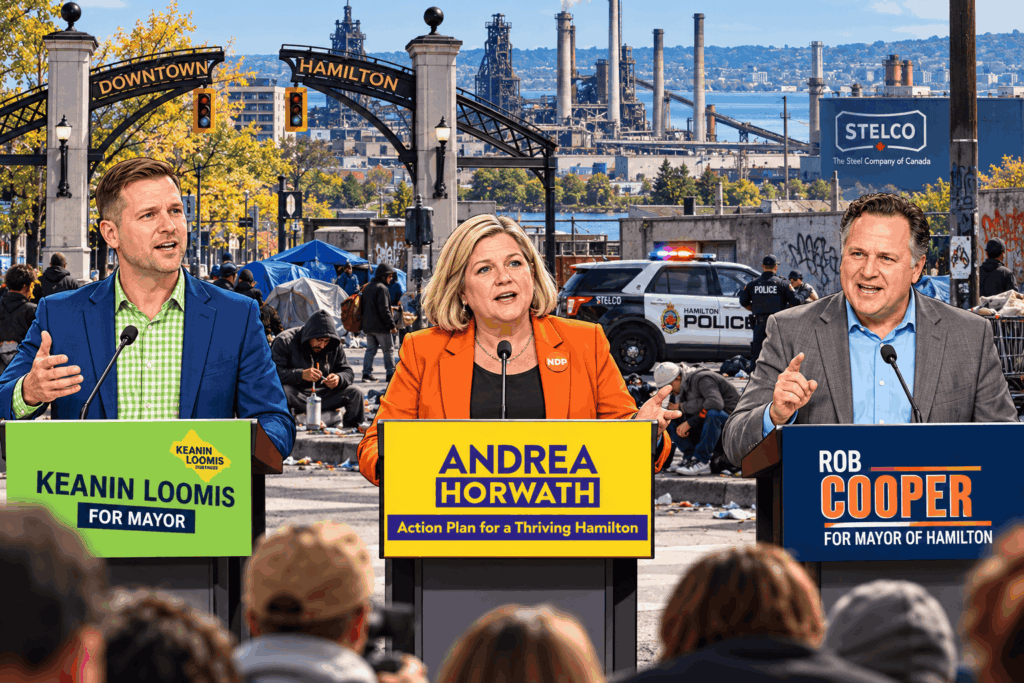
Hamilton is a tough place to be Mayor.
Back in April, Steve Paikin – the well-known Hamilton native, journalist, author and host of TVO’s The Agenda – made that very point in an article for TVO Today. Only one Hamilton mayor this century has managed to win a second consecutive term. “Hamiltonians seem to want to keep their mayors humble,” he observed. He called this year’s contest “dramatic.” I would second that.
Incumbent Mayor Andrea Horwath is facing a formidable fight and the polling numbers suggest this won’t be an easy re-election campaign. In 2022, Horwath edged out businessman and former Hamilton Chamber of Commerce president Keanin Loomis by just 1,663 votes. Out of more than 140,000 ballots cast, that translates to a razor-thin 1.17% margin!
Usually, a mayoral incumbent has an advantage that a challenger can only dream of: four years in the job, a public profile, and some kind of record to brag about. But incumbency can be a double-edged sword. It gives voters time to decide whether they want more of the same or a change. And if they aren’t happy, they know exactly who to blame.
And if the July 2026 Clear Impact Strategy poll is any indication, Horwath is in a tough spot. The survey, commissioned by Loomis’s campaign, found Loomis at 38.4%, Horwath at 24% and Ward 8 Councillor Rob Cooper at 22.1%. That puts Horwath 14.4 percentage points behind Loomis and just 1.9 points ahead of the third-place Cooper. The campaign that commissioned it has an obvious interest in the outcome, so the figures should be treated with that context in mind. Even so, the numbers raise a striking question: how has an incumbent mayor with such a long political résumé ended up in this precarious position?
Long-time NDP Parliamentarian Becomes Mayor of a Big City: Sound familiar?
Horwath is no political newcomer who stumbled into City Hall. She was elected to Hamilton City Council in 1997, became an NDP MPP in 2004, and led Ontario’s New Democrats for 13 years, from 2009 to 2022. From 2018 to 2022, she was Leader of the Official Opposition to Doug Ford’s first-term Progressive Conservative government. By the time she ran for mayor in 2022, she was already a familiar name not just in Hamilton, but across Ontario.
There are some fascinating parallels with Toronto’s struggling NDP Mayor Olivia Chow. Both women built lengthy political careers, including leadership roles in the NDP, before returning to municipal politics to seek the top job in their respective cities. Both won their first mayoral elections narrowly. And both now face tough re-election battles.
Why are these two veteran politicians having such a difficult time convincing voters to give them another term? There are many possible explanations, but one issue is hard to ignore: property taxes. Hamilton’s residential property taxes rose by 5.85% in 2023, 5.79% in 2024 and 5.6% in 2025, followed by a 3.87% increase in 2026. Compounded, that’s roughly 23% over four years! Toronto has had similar substantial tax increases (19%). To many, the details of city budgets can seem abstract. Tax bills, however, are very clear.
Keanin Loomis: The Sequel
So, who is Keanin Loomis, the man leading the July poll?
Loomis is a businessman who served as president and CEO of the Hamilton Chamber of Commerce and is now president and CEO of the Canadian Institute of Steel Construction. He is no stranger to Hamilton’s business community or its industrial economy. His campaign is focused on safer communities, better infrastructure, accountability and respect for taxpayers.
His background could prove particularly relevant at a moment when Hamilton’s steel industry is under enormous pressure. Stelco has begun issuing layoff notices as it moves ahead with plans to cut up to 500 jobs at its Hamilton plant. The first notices have just recently been issued, with the cuts expected to unfold over the next several weeks.
No mayor can single-handedly resolve an international industrial dispute or control the forces shaping the steel market. But Hamilton needs a mayor who can represent the city’s interests, work with other levels of government and speak credibly for workers and families facing the consequences of major job losses. Loomis’s business experience may be an asset for Hamilton in these troubled times.
Rob Cooper: The New Guy Is Turning Heads
Then there is Rob Cooper, whose polling numbers may be the biggest surprise of the campaign.
Cooper was elected to represent Ward 8 in a September 2025 by-election, winning by just 87 votes. Even though he has spent barely a year in elected office, the July poll placed him at 22.1%, just 1.9 percentage points behind Horwath. That is a remarkable showing for someone who only recently entered municipal politics.
Cooper is not short on professional experience. He holds an MBA and a CPA designation, among other impressive credentials, and his career has included senior roles at Ernst & Young, Stelco, TD Bank, Manulife, McMaster University and the Workplace Safety and Insurance Board. At Stelco, he served as vice-president of strategic initiatives and vice-president of finance and treasurer.
The newcomer’s campaign has put a spotlight on property taxes, city spending and violent crime. Cooper has argued that Hamilton needs tighter financial management, he has called for an end to tax increases that exceed inflation, and he has made tackling violent crime a central part of his platform.
That message is landing in a city where public safety remains a prominent concern. In Liaison Strategies’ October 2025 survey of voters in Ontario’s ten largest cities, 34% of Hamilton respondents identified crime as the most important issue facing their city – the highest share among the ten municipalities surveyed. Taxes came second at 15%, followed by homelessness at 12%.
Residents’ concerns about safety were front and centre at a Hamilton Police Service downtown safety summit in May 2026. Nearly 78% of participants said they felt unsafe downtown, according to reporting by CHCH. Open drug use and social disorder were the hot topics.
In campaigns, perceptions of safety can matter more than crime statistics. Hamilton’s Crime Severity Index fell in 2025, and police-reported violent crime also declined. But a statistical improvement does not automatically make residents feel safe walking downtown, nor does it erase the impact of a frightening incident. Recent stabbings and other high-profile episodes may not tell the whole story of crime in Hamilton, but they help explain why public safety has become such a potent election issue.
For Cooper, the challenge is to demonstrate that his financial and business experience can translate into effective leadership and that his proposals on crime and taxes are more than campaign talking points. For Horwath, the challenge of her campaign is to convince voters that her record and her plans deserve another term. And for Loomis, the task is to convince voters he has what it takes to do a better job than Horwath – and turn his polling lead into votes in the ballot box.
A city looking for answers
Hamilton’s mayoral race is about more than personalities. It is a contest about affordability, public safety, economic leadership and about which candidate can best tackle the serious issues that affect quality of life in Steeltown.
The July poll offers a snapshot, not a prediction. The campaign matters. But it’s clear that Horwath is struggling to hang onto the job. Relying on name recognition and incumbency alone won’t be enough to secure re-election, particularly when Hamiltonians appear to be looking for a change and her main opponent enjoys considerable name recognition of his own.
Will Andrea Horwath be able to overcome what Steve Paikin calls Hamilton’s local-governance “one-term-and-out curse”? Or will voters decide that four years is enough, that it is time for a new direction and a new mayor at City Hall?
Hamiltonians will decide on Monday.