The War on the Car Electric Vehicles

The War on the Car, Part 2: Electric Vehicles

In part one of this blog post, we looked at how municipalities have spent decades waging their quiet war on the car. Now, the big guns from higher levels of government are actively involved in the WOTC, through a most ingenious Net Zero policy: Electric Vehicle (EV) mandates. 

What do EVs have to do with the WOTC, you ask? After all, EVs are still “cars,” aren’t they? The answer can be found in the powerful economic principle of the law of supply and demand

For decades, the WOTC has focused on reducing the demand for cars by irritating drivers and making driving inconvenient or unpleasant – using the same propaganda playbook as outlined in part one of this blogpost, where we explored how municipalities have tried to shame people for using and enjoying their cars.

The demand for cars kept increasing, though.

In the 1970s, the shaming got underway in earnest. The Green Left prophesied about the impending global shortage of gasoline (derived from oil, of which we were allegedly running short). These predictions were, of course, wrong and by the 1980s, we instead experienced an oil glut. Some then complained about leaded gasoline, but unleaded gasoline and improved technology took care of that concern.

Then they tried to guilt us by saying that the internal combustion engine (ICE) automobile – even with unleaded gasoline – was still destroying the planet, and so they invented the fiction that electric vehicles were cleaner by magnitudes. But that ignores a simple truth: most of the world’s electricity still comes from hydrocarbons – oil, gas, and coal – so EVs are hardly “emission-free.” 

The population continued to increase and so did the demand for more cars. In Canada, the number of registered vehicles has more than tripled since the 1960s from 8 million to 26 million in 2023 – 3.4% of which are zero-emission vehicles. 

Some upper-middle-class virtue-signallers did eagerly snap up the taxpayer-funded “rebate” subsidies for their more expensive EVs before they ran out (to make the virtue-signalling a little less painful, but also, well, a little less virtuous). Minus incentives, however, few people were swayed by the pure and simple temptation to virtue-signal through EV ownership.

In other words, everyday Canadians haven’t been buying-in – not into the propaganda, and not into EVs.

While governments here in Canada, the USA, and abroad have been spending billions to subsidize the manufacture of these EVs, taxpayer-subsidized efforts still haven’t been able to get the price down low enough to attract working families to buy them. Nor have they been able to guilt citizens into simply paying more for an EV so they can show their neighbours just how good and “virtuous” they truly are!

So the Green Left and their partners in government have recently shifted to the supply side of the equation instead. 

Attempts to guilt or pressure drivers into buying electric vehicles (EVs) have failed. Demand for ICE vehicles remains strong, so lawmakers and the Green Left have shifted tactics, now aiming to reduce the overall supply of cars instead.

The federal Liberal government remains fixated on its Net Zero agenda, clinging to the Trudeau-era policy that, by 2035, 100% of vehicles sold in Canada must be electric. Even though Prime Minister Carney announced in early September a supposed “review” of the EV mandate and a temporary pause on the 20%-by-2026 sales target, make no mistake, the Carney Liberal government is still fully committed to the 60%-by-2030 and 100%-by-2035 targets. 

The Liberals’ aggressive plan to force Canadians into EVs through mandates is more than mere virtue-signalling, it’s fundamentally unachievable. There is simply no realistic scenario – by 2026, 2030, 2050, or ever – where enough EVs could be built to meet the current and projected demand for automobiles in North America.

The Liberal government and their Green Left allies in municipalities across Canada know this perfectly well. But here’s the twist: it’s not a flaw in the plan. It is the plan.

By making EVs scarce and pushing gas-powered cars off the market, they’re creating a future with fewer cars, fewer drivers, and less freedom of movement.

Maybe that’s been the goal all along.

The War on the Car Electric Vehicles

The War on the Car

Remember the “war on the car”?

For decades, municipalities around the world have been waging a relentless war on cars and their drivers. The left, including but not limited to the green left, claims this war is in defense of the environment. But they also seem to dislike the many benefits of automobiles – comfort, convenience, personal safety, economic growth, freedom, support for families, individual flourishing, and so on.

But how have they been conducting this war on the car (WOTC)?

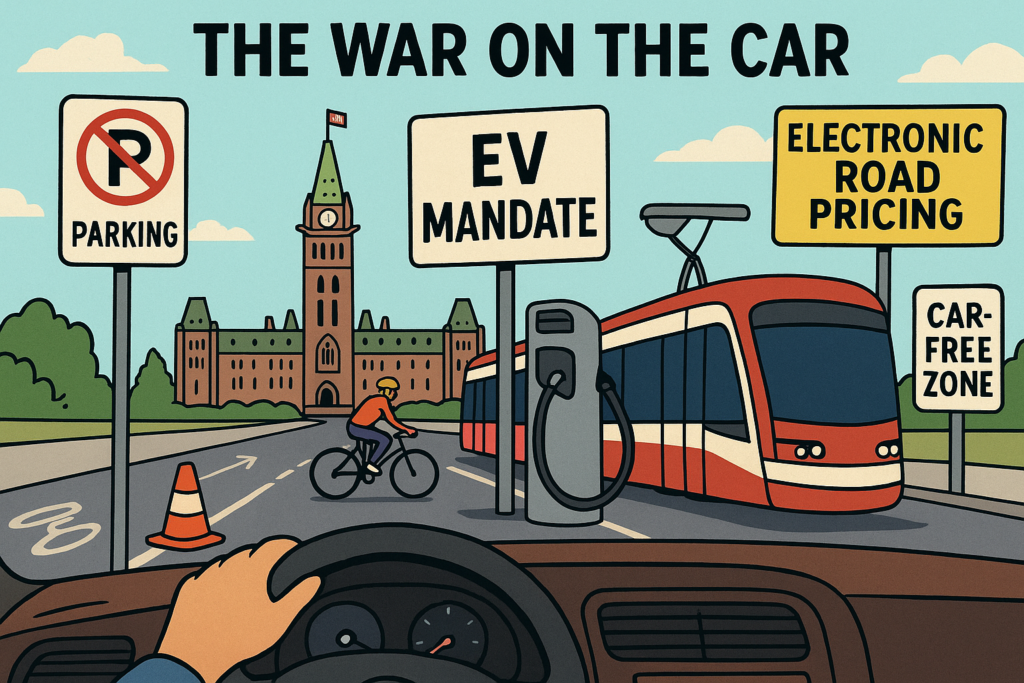
London is famous for its £15 per day congestion pricing and Ultra Low Emission Zones (ULEZ). Numerous other large cities have experimented with various parking restrictions, including “car-free zones,” “no-drive days,” Electronic Road Pricing, and Low-Traffic Neighbourhoods. And then there is the Orwellian “15-minute city,” perhaps the ultimate municipal WOTC move.

Here in Canada, and elsewhere, an especially punitive tactic of the WOTC has been led by municipalities building Light Rail Transit (LRTs). The urban and suburban left have been pushing these above-ground electric trains, which invariably make for more traffic congestion on key thoroughfares. Ask drivers in Vancouver, Edmonton, Calgary, Mississauga, Brampton, Toronto, and Ottawa about these over-priced and under-used congestion-creating monsters. Drivers who succumb and attempt to use transit instead of their cars are often rewarded by crowding, delays and breakdowns. Ottawa’s LRT has been notorious for its unreliability, especially in winter.

And let’s not forget the municipally mandated and now ubiquitous bike lanes. In Toronto, the issue ended up in court after the Ontario government attempted to remove bike lanes from just two heavily clogged arteries. Recently, an Ontario Superior Court of Justice determined that the government’s plan to remove the bike lanes was, incredibly, unconstitutional. The Ontario government promptly appealed this decision, so we await the final word as to whether this will ultimately be a victory for the anti-car movement and its zealotry to make it tougher to drive in Toronto.

The Toronto Star recently devoted an entire column to talking drivers out of their cars, encouraging folks to join the “car-free movement” (is that a thing?) and adopt a more enlightened “mindset” to car ownership. I gather this involves a lot of walking, cycling, ridesharing and even a passing suggestion to offset costs by taking on deliveries. (Is the Star recruiting for Amazon now?)

The condescending tone doesn’t stop there. If you cannot adopt a “car-free mindset,” the Star offers this handy advice for drivers: remove shoes from your trunk and back seat to reduce drag, and shop around for better car insurance rates. (The Star seems unaware of the common practice of keeping a bag of salt or kitty litter in the back to improve winter traction.) Has the “personal finance reporter” who authored this article ever met any average Canadians? Intelligent people who manage their finances responsibly and make informed decisions every day on how to save and spend their own money?

There’s no doubt that a car-free lifestyle is possible and perhaps not too painful if one resides in a dense, urban setting, works from home, and lives a simple lifestyle. Many Torontonians, and perhaps even Calgarians and Vancouverites who reside in the city centre, can use public transit, Uber, walk to get where they need to go, and rent a car for longer trips outside the city. Cars aren’t a luxury for millions of Canadians, however. They are the foundation of livelihoods and lifelines for maintaining a decent quality of life, enabling individuals to keep their jobs, support their families, care for loved ones, and participate fully in their communities.

Recently, the Toronto Sun reported on something called Build Toronto, ostensibly a group of local residents who “spotlight bold ideas” such as charging a toll of $10 to $15 each time a car enters the city. “A sin tax on human mobility” is what 2023 Toronto mayoralty candidate Anthony Furey calls it.

Author Joe Warmington correctly labels it “a congestion tax to fund green ideology,” which will hurt those with lower incomes much more than the ones who can afford Teslas, live in the city, and only enter it when they’re returning home from a weekend at their cottage in Muskoka.

Speaking of Teslas, my next column will argue that the electric vehicle “craze” – if you can call it that – embodies a malicious and powerful escalation of the WOTC. Stay tuned.