
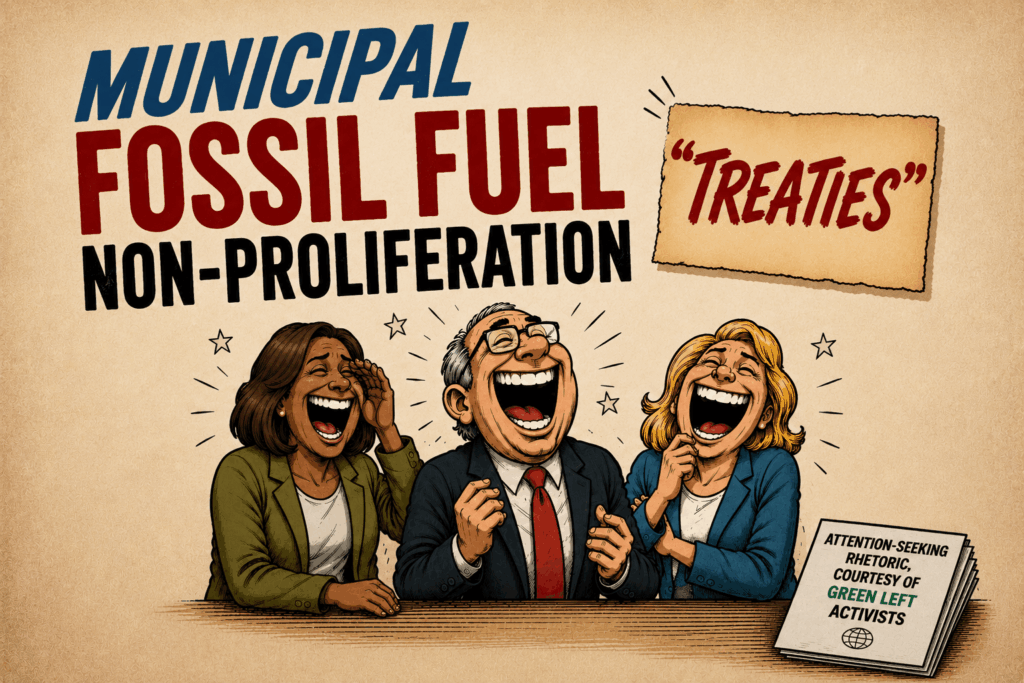
I came across yet another example of municipal madness recently: 18 Canadian municipalities and regional districts have officially endorsed the global Fossil Fuel Non-Proliferation Treaty Initiative.
Two-thirds of the municipalities are in British Columbia. Three are in Quebec. Three are in Ontario – Toronto, Ottawa, and Mississauga.
Ever heard of this “treaty”? Probably not.
The reason is simple: treaties are normally formal, legally binding agreements negotiated between governments. This “treaty” is something else entirely – a public relations ploy designed to borrow the prestige of real treaties while advancing a political campaign against fossil fuels. The not-so-small print advocates ending new oil, gas, and coal development worldwide, with a “gradual” phasing out of existing fossil fuel production, and replacing it with renewable energy through an internationally coordinated “transition.”
Ordinarily, the phrase “non-proliferation” has been paired with nuclear weapons – instruments capable of destroying entire cities, potentially ending civilization, and rendering vast swaths of the planet uninhabitable in a matter of moments.
This is a bit different. The green propagandists pushing this nonsense are using language designed to get your attention. Perhaps they are getting desperate.
“Fossil fuel non-proliferation” wasn’t a concept I had ever heard of until a little bird at Mississauga City Hall whispered it in my ear.
The vote in Mississauga, by the way, was unanimous. That means even the councillor I spoke with voted for the essentially meaningless propaganda.
Meaningless because comparing fossil fuels or hydrocarbons to nuclear weapons is fundamentally disingenuous. Oil and gas are safe sources of energy and do not pose a threat to world civilization.
So why the extreme language? Why have so many municipalities fallen for such ridiculous rhetoric?
Let me remind you of another municipal, pre-COVID-19 pandemic, fad: the climate emergency declaration hoax.
Back in 2013, activists on the Green Left had grown dissatisfied with phrases like “global warming” and “climate change.” Neither was generating sufficient urgency. Governments were not acting – at least not fast enough or dramatically enough for the movement’s most ardent supporters.
So the terminology evolved.
Suddenly we weren’t facing mere climate change. We were facing a climate emergency.
Before long, municipal climate emergency declarations spread across Canada like wildfire. Councils eagerly adopted the language. Environmental plans were rewritten. Councillors congratulated themselves for recognizing and highlighting the problem.
It all seemed harmless.
But it wasn’t.
Those declarations were mostly ignored for a while, eclipsed by a newer and far more fashionable emergency in 2020: COVID-19 (and 2021, 2022, 2023…). Yet despite those pandemic headwinds, the climate “emergency” never really went away. In many municipalities, it became the justification for millions of dollars in spending – taxpayer dollars disappearing into a fog of vaguely defined climate initiatives. The “emergency” slowly worked its way into budgets and spending decisions across virtually every municipal department.
That continued for the better part of a decade, and is still with us. A thaw in the emergency is on the horizon, however. Last month, Calgary became one of the first major Canadian cities to reverse course and rescind its climate emergency declaration. Councillors cited affordability concerns and an inability to effectively “follow the money” flowing from expenditures justified under the emergency banner.
The lesson should be obvious.
Equating fossil fuels with nuclear weapons is the same tactic. It is purposeful, outrageous, and ridiculous fear-mongering. It is language designed to shock, provoke, and create a false sense of crisis.
While the motion may be largely meaningless, it is not harmless.
First, while association alone is not proof of bad judgment, a cursory glance at the countries that have endorsed the treaty raises some red flags.
The list includes Vanuatu and Tuvalu in 2022; Tonga, Fiji, the Solomon Islands, Niue, East Timor, Antigua and Barbuda, Palau, Colombia, Samoa, and Nauru in 2023; the Marshall Islands, the Bahamas, and Pakistan in 2024; and Cambodia more recently. The initiative has also been endorsed by the World Health Organization, the European Parliament, and the Vatican.
I don’t wish to insult any of these countries, but what does it say that there isn’t a single G7 nation on the list? Not one major developed economy.
And what does it say about Canadian municipalities that they are so eager to join such an anti-illustrious club?
Canada would be disproportionately harmed by any meaningful action on this “treaty” because Canada is a resource-rich nation. Implementation would restrict energy development and economic growth, increase energy costs, reduce energy security and transfer significant economic and political authority to international institutions and treaty bodies.
Also, many of the treaty’s most enthusiastic supporters produce little or no fossil fuel themselves, meaning the economic burden would fall overwhelmingly on major producing countries like Canada.
Translation: Canadians pay more, have fewer opportunities, and get a lower standard of living in the bargain.
This has to stop.
Councillors, your responsibilities are already enormous. Look after roads, sidewalks, water systems, sewers, public transit, waste collection, parks, community centres, policing, fire protection, zoning, planning, public health, and local economic development.
There is more than enough genuinely important work in your own backyard to keep you busy for a lifetime.
Resist the temptation to reach halfway around the world looking for the latest global fad to awkwardly graft onto local government because, if history is any guide, today’s seemingly harmless virtue-signalling resolution becomes tomorrow’s costly spending program.
Let’s hope Canadians don’t have to endure ten years of fossil fuel non-proliferation initiatives before some future mayor, armed with a morsel of common sense, realizes the whole thing was misguided and undertakes the gargantuan task of unwinding it all.