
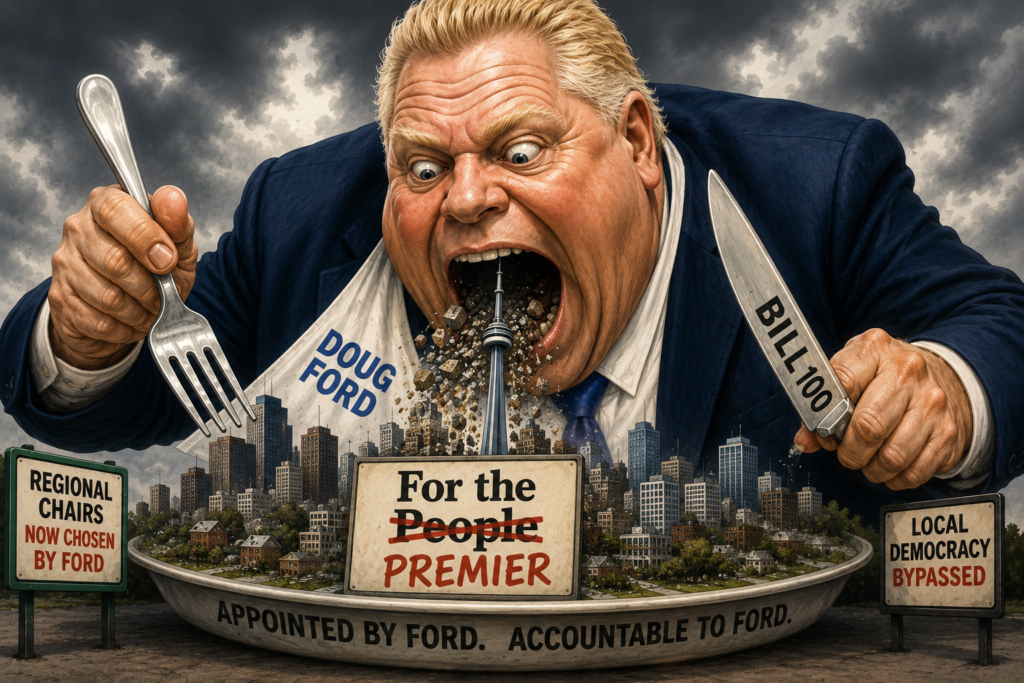
In 2018, Doug Ford’s Ontario PC party swept into power using the slogan, “For the People.”
Today, that slogan is rarely used by Ford, and it’s a good thing too! ”For the People” has become increasingly difficult to reconcile with his increasingly authoritarian governing style and contempt for the very people who elected him.
Ford’s latest attack on local democracy comes just three months before Ontarians vote in this year’s municipal elections on October 26, 2026.
What has Ford done this time? Earlier this year, Ford’s Minister of Municipal Affairs introduced Bill 100, the Better Regional Government Act. Thanks to Ford’s Progressive Conservative majority, the Ontario Legislature passed this anti-democratic legislation and it became law.
But is it really better?
Hardly. Not for voters. Not for local democracy. It does, however, concentrate more power in the Office of the Premier.
What does Bill 100 do? It is the latest step in Doug Ford’s steady centralization of power – taking decision-making away from “the people” and consolidating it where he appears to believe it belongs: in his own hands.
Bill 100 gives Ford the power to appoint the Chairs of Ontario’s eight regional and district municipalities – even the ones that had for years been electing them by popular vote.
Bill 100 is a backward step for democracy and accountability, and this is no sudden development.
Since becoming Premier in 2018, Ford, who failed in his own bid to become Toronto mayor in 2014, has been using provincial powers to exact his revenge on municipal voters and local politicians.
How Regional Government Works – and Why it Matters
The Canadian Constitution establishes only two levels of government – federal and provincial. Municipal governments exist because provincial governments create them, and the provinces have complete authority to establish, regulate, structure and restructure local government as they see fit. So Doug Ford, whose party holds a majority in the Ontario Legislature, unquestionably has the legal authority to make local government as democratic – or as undemocratic – as he chooses.
Of the 8 regional governments in Ontario, six are heavily urban and specifically designated as “regional municipalities.” In the Greater Toronto Area, there are four: Peel, York, Durham and Halton. West and south of Toronto, there are two others: Waterloo and Niagara. Muskoka and Oxford County are “district municipalities,” which, for the purposes of selecting their leadership, are treated the same as the other regional municipalities.
All eight of these regional governments are “two-tier,” meaning there is an upper-tier regional government responsible for services such as policing, regional roads, public transit, public health, paramedic services, water and wastewater, waste management, and regional planning, while the lower-tier municipalities (cities and towns) are responsible for local roads, parks, recreation, libraries, local planning, fire protection, and other community services.
To use one example, in Peel Region, where I once served as a Member of Parliament, there are three lower-tier municipalities – the Cities of Mississauga and Brampton and the Town of Caledon – together with one upper-tier government, the Regional Municipality of Peel, which is responsible for regional services for all three municipalities.
Three Decades of Expanding Local Democracy
Prior to Ford’s election in 2018, under successive Progressive Conservative and Liberal governments, Ontario’s regional governments had been evolving over several decades toward greater democratic accountability. Until the 1990s, the chair of each regional council was typically chosen by the locally elected regional councillors. Technically, there was no legal requirement that the chair be an elected official. In practice, however, appointing an unelected chair was rare. Indeed, the last notable example of this occurred in 1992, when Peel Region selected a former mayor who was not at the time an office holder.
In the 1997 municipal elections, Waterloo Region became the first regional municipality to adopt the direct election of its Regional Chair. The change was initiated by the Region itself and approved by the Mike Harris PC government. The Harris PCs later authorized Halton Region to follow suit for the 2000 municipal election. Years later, after Durham Region voters approved the direct election of their Regional Chair in a 2010 referendum, the Wynne Liberal government completed the necessary legislative changes in time for the 2014 municipal election.
In 2016, the Ontario Legislature amended the Municipal Act to require four remaining holdouts – York, Peel, Niagara and Muskoka – to hold direct elections for regional chair (or “district chair” in the case of Muskoka). (Oxford County, which already elected its head of council or “warden” directly, was unaffected by the change.) Although the change was imposed by Queen’s Park rather than requested by the affected municipalities – a debatable approach – it was nevertheless enacted in the spirit of giving a direct voice to voters in choosing their regional leader, replacing a process that had long been controlled by elected councillors behind closed doors.
The pattern is clear. Both PC and Liberal governments alike moved Ontario toward greater democratic accountability, first by permitting, and later by requiring, the direct election of regional chairs. By 2016, the transition was nearly complete.
Then Came Doug Ford, against the people
Perhaps it should not be surprising that Ford has shown so little regard for the traditions of local government. Before becoming Premier, his entire elected political résumé consisted of a single four-year term as a Toronto city councillor, serving during the tumultuous mayoralty of his brother, Rob Ford. It was a remarkably narrow apprenticeship from which to redesign the democratic governance of every municipality in Ontario.
Despite his “For the People” slogan, his government has spent the years since 2018 dismantling that bipartisan legacy and shifting power away from voters.
Doug Ford became premier in June 2018, just months before Ontario’s scheduled municipal elections. That summer, the Ontario Legislature was recalled for a rare emergency session to pass new legislation that, among other things, repealed the impending direct election in the holdout regions of York, Peel, Niagara and the District of Muskoka. The elections for regional chair were famously, or infamously, cancelled, even though campaigning was already underway.
While some local politicians in these regions undoubtedly welcomed the return to the old insider system of selecting their respective regional chairs, their self-serving satisfaction proved short-lived. In 2022, apparently no longer content merely to deny voters a direct voice, Ford launched an even more sweeping new power grab.
The Premier Hand-Picks the Winners
Just before the 2022 election, the Ford government’s PC majority amended the Municipal Act once again, eliminating completely the role of local councillors in selecting regional chairs in Peel, York and Niagara. For the 2022 to 2026 term, it would be Premier Ford himself, through his Minister of Municipal Affairs, who would personally appoint the chairs in these regional governments!
That arrangement clearly suited Ford. Having centralized the appointment power into his own office, he soon decided to go even further. In 2026, the Ford government passed the Better Regional Governance Act, overturning a system of direct election in Durham Region that had been used successfully in three municipal elections and, more importantly, had been approved by voters themselves (the people!) in a 2010 referendum.
Ford didn’t stop there. His 2026 legislation also reversed reforms introduced by the Harris PC government nearly three decades earlier. Direct election of regional chairs in Halton and Waterloo was eliminated as well. So much for governing “For the People.”
Even worse, Ford did more than eliminate the direct election of regional chairs. Following the precedent he set in 2022 in York, Peel and Niagara, he also removed local elected officials from the selection process altogether. Beginning immediately after the 2026 municipal elections, the appointment of every regional chair in Ontario’s upper-tier municipalities will rest with Ford himself, acting through his Minister of Municipal Affairs – including in regions where voters had been choosing their regional chair directly for decades.
Ford’s appetite for centralized power seems to know no limits. What began by denying voters a direct voice has culminated in the unprecedented concentration of appointment power in the hands of the Premier.
The Most Powerful Regional Chairs Ever – and They All Owe Their Jobs to Ford
Bill 100 goes even further. Ford has also granted his appointees the same “strong mayor” powers already extended to many municipal mayors, creating the most powerful regional chairs in Ontario’s history.
Provided they support certain Ford-designated provincial priorities, these Ford-appointed regional chairs will be able to propose and pass certain bylaws with the backing of just one-third of regional council. Conversely, they will be empowered to veto bylaws adopted by a democratic majority if, in their opinion, those bylaws conflict with Ford’s provincial priorities.
In effect, Ford has created a system in which the most powerful person in every regional municipality will no longer owe that position to the voters – or even to local elected representatives – but to the Premier himself. A mandate from Ford to pursue Ford’s priorities – and the arbitrary, Ford-style, near-dictatorial powers to impose them.
I am not alone in finding Ford’s latest power grab deeply troubling. The Association of Municipalities of Ontario (AMO), which represents Ontario’s municipal governments, has condemned the changes and urged the province to repeal Bill 100, stating that “appointing regional chairs with ‘strong chair’ powers is fundamentally undemocratic… We want to keep the selection of regional chairs and county wardens local.” AMO further warned that the legislation “erodes accountability to voters, undermines the ability of local governments to reflect community needs, and risks concentrating power at the provincial level.”
Governments Change. Powers Remain.
For those who still support Doug Ford and are tempted to dismiss these changes as harmless because they trust the current government, consider this: governments change, but the powers they acquire remain.
One day, Ontario will once again elect a Liberal or NDP government. When that day comes, it will inherit every one of the centralized powers Doug Ford has accumulated. It will decide who serves as regional chair. It will determine the “provincial priorities” that justify overriding local decision-making. And it will exercise the very powers that today’s government insists are necessary.
If voters truly believe in local government, democratic accountability, and limiting the concentration of political power, they must oppose these changes now – not after someone else inherits them.
Governments change. And the question is not whether we trust today’s Premier. The question is whether we are willing to entrust these extraordinary powers to every Premier who follows.