
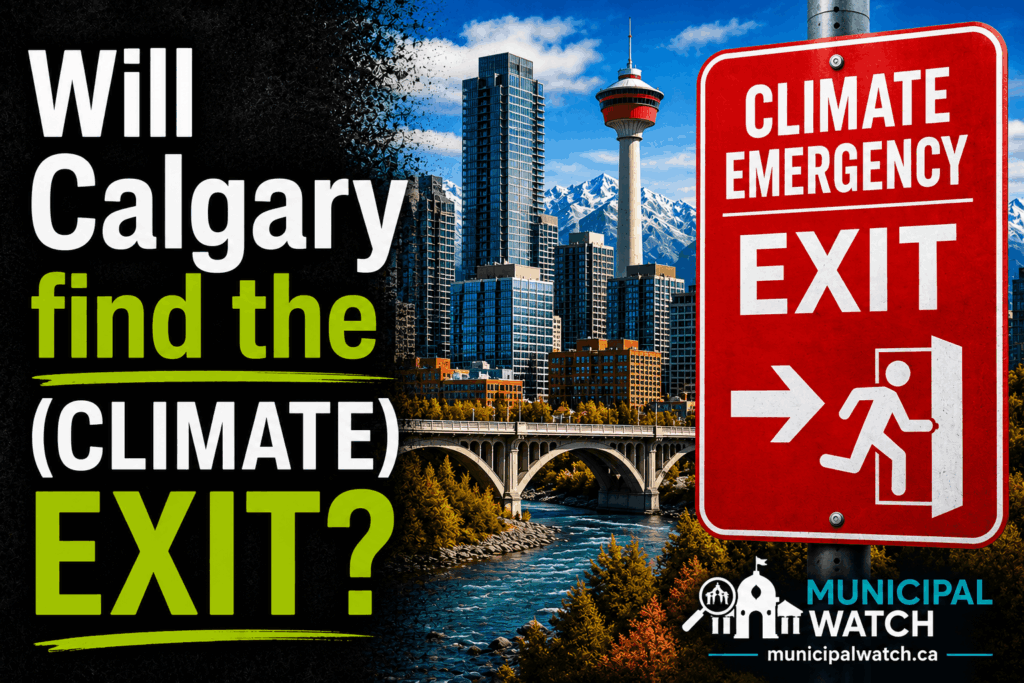
Once again, Calgary City Council is ahead of the curve. From what I can tell, it’s the first Canadian municipality to delve into the real meaning and consequences of its climate emergency declaration.
Like a teacher playing favourites, I’m going to single out the city of Calgary once again, this time for forging a path and doing the right thing – or at least appearing to want to do the right thing.
With a new mayor and some new councillors, things are really looking up in Calgary. And Municipal Watch hopes other cities and towns in Canada are taking notice.
What issue am I talking about?
Five years after declaring a “climate emergency,” Calgary’s current city council is looking at possibly… maybe… undoing the policy.
One of the two motions on the subject was put forward by Andre Chabot, a six-term councillor who points out that using the term “climate emergency” is “largely symbolic” but not harmless because it leads to significant expenditures. In other words, it’s costly – to taxpayers! – to virtue signal in this way.
Let’s face it: when the previous council passed this declaration in 2021, it wanted to appear to care about an issue that was, at the time, higher on Canadians’ list of priorities. But that was before affordability and trade issues reshaped the political landscape and pushed nearly every other issue aside.
Credit to Chabot for including a full audit of all climate-related spending in his motion. With a $26 million budget, the climate and environment department is not exactly operating on chump change.
But that specific department’s spending allotment is just a fraction of the approximately $214 million that Chabot says the city is spending on climate-related line items this year.
There’s little doubt that many “embedded” climate costs are, in fact, “hidden.”
This is Councillor Chabot’s second attempt to bring this issue to the fore. In September of 2025, he and only three other members of council voted for a similar motion to rescind the emergency declaration. Back then, the motion was sponsored by then-Councillor Sonya Sharp (who ran for Mayor a month later but lost narrowly to current Mayor Jeromy Farkas).
Back in 2021, Calgary Council voted overwhelmingly (13-2) in support of calling climate change an “emergency,” but Sharp herself was one of the councillors who changed her mind. She initially viewed it as a harmless gesture (aka virtue-signalling), but eventually concluded that it simply created “open-ended spending obligations without a clear return.”
Yep, open up the chequebook and call it climate change investment. Funny how green money always seems to grow on someone else’s tree!
The political atmosphere was already heating up ahead of the mayoral campaign, though, and Sharp quickly became the target of accusations of climate “denialism” and the usual assortment of green activist name-calling.
One particularly solid councillor of the common-sense variety, Dan McLean, invoked the definition of the word “emergency”: a “sudden and temporary event that requires urgent, coordinated action to protect people, property, and the environment.” When you look at it, that way, he concluded that “climate change does not qualify.”
“It’s a long-term, global challenge that must be addressed through steady, responsible decisions, largely by other orders of government,” he added. Well, thank you, Councillor McLean, for stating that so simply. Changing the temperature of the planet is under the purview of the federal government!
Have these hundreds of millions of dollars produced any “real, tangible results?”
Somewhat telling was the response by a member of city staff when asked about the possible repercussions of eliminating climate emergency language from city documents and by-laws. City staff pointed out, as one would expect, that much funding from other levels of government (namely federal) is dependent on these performative climate emergency declarations. The city’s bureaucrats are concerned that the Carney Liberal green funding taps will be turned off. Leveraging pots of cash from other sources is, after all, a significant part of their job descriptions.
First-term councillor Landon Johnston put forward his own motion, which also calls for the scrapping of climate emergency declaration references. His motion emphasizes the insidious nature of this phrase which gets mentioned in most, if not all, of the city’s plans, communications, and websites.
Johnston looked into the city staff contention that it was necessary to keep the language intact in order for the city to leverage pots of federal green cash. He found that none of the funding programs were tied to the emergency declarations, but rather to the city’s overall environmental protection plans. In other words, Calgary could continue with practical measures like mitigation and adaptation, without risking green Liberal largesse.
Councillor Chabot considers the two motions as complementary and stressed that both seek to focus on the aspects that are “measurable and quantifiable”; that is, spending that makes sense and which improves quality of life, with direct benefit to Calgarians versus unrealistic, bureaucratic practices that don’t work and negatively affect the lives of ordinary citizens.
“Climate change isn’t something we can do as a city,” said Councillor Chabot, suggesting instead that reducing airborne pollutants, pursuing adaptation and mitigation measures, and cutting bureaucratic climate red tape (on housing policy, for example) would go much further toward improving life for Calgarians in the long run.
As a city, creating environmental standards is acceptable, but imposing climate policy restrictions and red tape on ordinary citizens is “overreach,” Chabot said. “At a municipal level, we have core responsibilities that are delegated by other levels of government to fulfil.”
Well said. When cities spend time and money embedding meaningless climate-emergency language into every aspect of their work, intricately woven and difficult-to-track spending often follows. And it takes away from the time, funds and commitment they should be spending in their own backyards – literally.
The two motions will be debated at a future Calgary City Council meeting. Let’s hope that happens soon and that it spurs other municipalities to begin examining their own not-so-harmless, not-so-urgent, climate “emergency” declarations.