
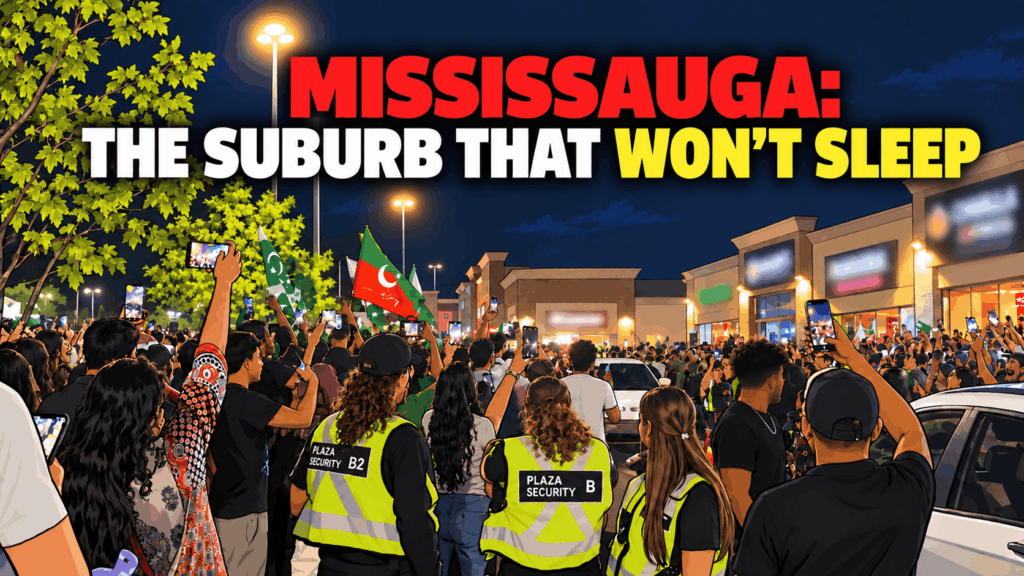
Something interesting is happening in Mississauga.
A recent Liaison Strategies poll found that 46% of Mississauga residents believe their city is moving in the wrong direction, compared with only 32% who think it is moving in the right direction. In politics, those are significant numbers. People in Mississauga are not happy. Why not?
Here’s a clue: 45% said Mississauga is less safe than it was a year ago. Only 12% said it is safer, while 31% said it is about the same.
So, when half of its residents say the city is headed in the wrong direction – and nearly half say they feel less safe than they did just a year ago – it is worth asking why.
One possible piece of the puzzle is a place that has become something of a household name in Mississauga: Ridgeway Plaza.
The Ridgeway Plaza Problem
Built in 2022 in what had previously been a relatively quiet residential neighbourhood, Ridgeway Plaza quickly became a hugely popular destination. It is a collection of restaurants and shops, particularly known for halal food, and has attracted thousands of people from Mississauga and well beyond.
There is absolutely nothing unusual or problematic about that.
Mississauga is Canada’s eighth-largest city, with a population of approximately 770,000. It sits immediately west of Toronto, is slightly larger than Vancouver and slightly smaller than Winnipeg, and is home to Toronto’s major international airport. It is also one of the country’s most ethnically diverse cities.
A diverse city should have diverse restaurants, shops and gathering places. In fact, the popularity of Ridgeway is a testament to the entrepreneurial energy and cultural diversity of Mississauga.
The problem, according to a City news release, is that the plaza has also become associated with overcrowding, excessive late-night noise, illegal fireworks, illegal patios, street racing and stunt driving, physical fights and altercations, threatening and aggressive behaviour, blocked emergency access and other safety concerns.
None other than The New York Times took notice, publishing an article in March 2026 titled “The Suburb That Won’t Sleep.” The newspaper described Ridgeway as having grown to approximately 120 restaurants, primarily Middle Eastern and South Asian, and noted that it attracts thousands of diners each week.
This wildly popular commercial destination grew faster than the surrounding infrastructure and municipal rules could accommodate, however.
As The New York Times reported, the popularity of the plaza has brought noise, litter, traffic, insufficient parking, confrontations, physical fights, illegal fireworks and street racing.
Those are legitimate municipal problems that require solutions because they affect the people who live nearby.
When Cultural Celebrations Meet Neighbourhood Peace & Quiet
There is another layer to the story, however, and this is where things get more complicated.
Certain culturally significant days have drawn particularly large crowds to the area. Unsanctioned (planned but not permitted by the city) events surrounding Pakistan and Afghanistan Independence Days, as well as National Iraqi Day, have at times attracted thousands of people.
The City itself said some of these gatherings had repeatedly created problems with its ability to maintain roads safely, control traffic, respond to emergencies and enforce municipal bylaws.
A Pakistani-Canadian physician and regular Ridgeway diner, Dr. Ilmana Fasih, offered an insightful perspective. She told The New York Times:
“I love my culture, but then I’m also critical of some of the things that we do which annoy people and which are different, because every culture has a different nuance.”
She immediately added another important point: “There are problems with us, and there are problems with racism in Canada also.”
That is probably a more useful way of looking at this than pretending that a problem doesn’t exist.
Matt Mahoney, Mississauga’s deputy mayor and the councillor whose ward includes Ridgeway Plaza, has also pushed back against the idea that the problem can simply be blamed on poor city planning. As he has pointed out, the City cannot dictate what type of businesses operate in a privately developed plaza.
Yet he has also described Ridgeway as a place that, beyond the food, has become known for “chaos.”
When the City Had to Step In
By December 2023, the problem had become serious enough that Mississauga Council, led by then-Mayor Bonnie Crombie, adopted a Nuisance Gathering By-law, which took effect January 1, 2024.
It was one of Crombie’s final acts as mayor before she resigned to seek the leadership of the Ontario Liberal Party.
The Nuisance Gathering by-law wasn’t enough.
Large unsanctioned gatherings continued. Some drew more than 3,000 people. Emergency fire routes were blocked. There were illegal fireworks, very late-night noise, street racing, stunt driving and physical altercations.
Eventually, under newly elected Mayor Carolyn Parrish, Mississauga took the extraordinary step of going to court.
The City obtained an injunction restricting nuisance gatherings at Ridgeway Plaza and giving police additional authority – and the obligation – to restrict traffic and deal with violations. The injunction specifically covered periods surrounding Pakistan Independence Day and Afghanistan Independence Day in 2025.
Seeking and obtaining a court injunction is a pretty remarkable escalation for a suburban shopping plaza that opened only a few years ago.
Chaos: A Municipal Problem in Mississauga
Mississauga is a multicultural city. Its population includes large communities from South Asia, the Middle East and many other parts of the world. People have every right to celebrate their heritage, eat the food of their home countries, gather with friends and maintain cultural traditions.
But the same rules must apply to everyone.
Celebrating your heritage doesn’t give anyone the right to block a fire route. Driving dangerously isn’t acceptable because the gathering happens to be culturally significant. Illegal fireworks don’t become legal because they are part of a celebration. And residents shouldn’t have to put up with excessive noise or unsafe streets because a particular event attracts a large crowd.
That balance is precisely what municipal government is supposed to manage.
Why Does This Matter in the Mayoral Race?
Interestingly, Ridgeway Plaza and the related controversies don’t appear to have become major issues in this year’s mayoral race – at least not yet.
Perhaps that’s because tensions have subsided somewhat following the City’s tougher approach, including the court injunction. Or perhaps none of the leading candidates wants to touch such a sensitive subject during an election campaign.
And perhaps that’s understandable, but the underlying questions haven’t disappeared.
How does a rapidly growing city accommodate new businesses and new communities without overwhelming established neighbourhoods?
How does a municipality protect cultural expression while enforcing the same rules for everyone?
And what happens when residents begin to feel that their neighbourhood is changing faster than their government can manage?
These are legitimate questions for voters to ask their local candidates.
And that is why Ridgeway Plaza is worth watching.
Because when 46% of residents say their city is moving in the wrong direction and 45% say it is less safe than it was a year ago, politicians should probably be asking why.
Calmer, But Not Quite Settled
Since the injunction, things do appear to have improved somewhat, at least in terms of the city’s ability to control the large gatherings. The temporary court order proved effective, and in April the city and the plaza’s condo corporations reached an agreement involving cameras, gates, speed bumps, additional security and increased parking enforcement. Whether any of that has actually solved the underlying problems is another question, as the city has yet to publish meaningful before-and-after data, and complaints about traffic, noise, and safety have continued.