
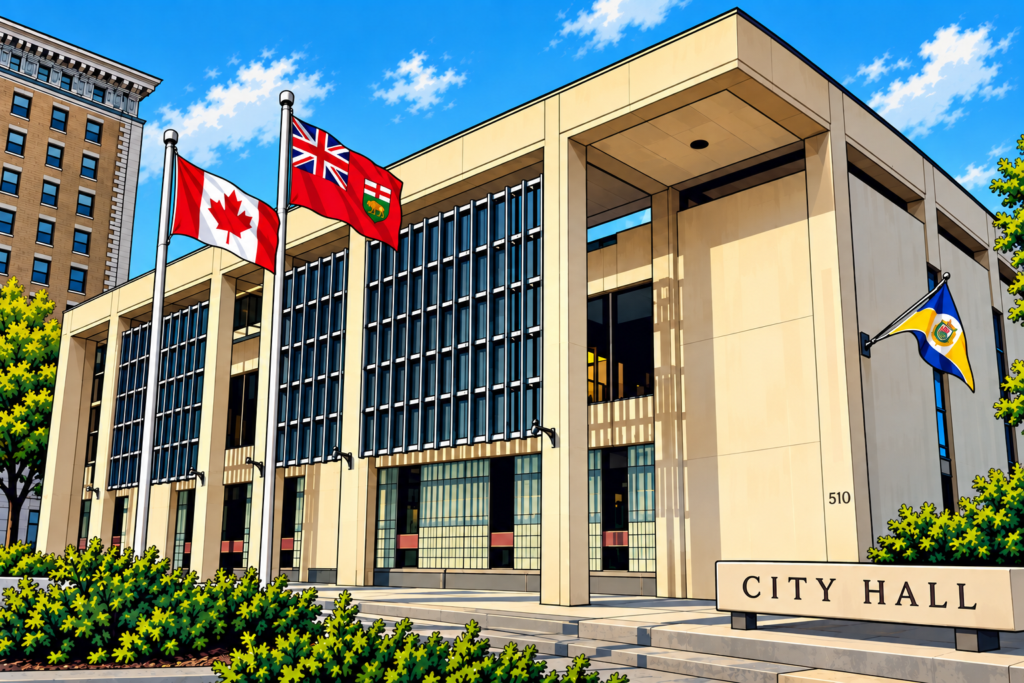
There is a recent tradition in Winnipeg politics that is in serious danger of being shattered.
Since the 1990s, every Winnipeg mayor has been elected to serve at least two full terms, and most have served no more than two before retiring. Three or more terms for a mayor are rare.
Turfing a mayor after a single term? Unheard of!
Yet this might be the year when Winnipeggers decide to turf their one-term mayor.
Is Scott Gillingham in trouble?
What has gone wrong for Winnipeg’s first-term mayor Scott Gillingham? Why is he so unpopular? And is there anyone in a position to defeat him?
A public opinion poll published in late spring indicated that Gillingham was in serious trouble. According to a Probe Research survey conducted for the Winnipeg Free Press from May 25 to June 8, 2026, 46% of Winnipeggers did not want to see Gillingham re-elected, while just 19% wanted him to win again, and 36% were unsure.
Behind those numbers was a broader sense of dissatisfaction: about two-thirds of respondents said that “quality of life” had deteriorated since Gillingham’s 2022 election as mayor, with the major issues being crime, homelessness, and addictions.
Winnipeggers were also pessimistic about the chances of things getting better. Only 8% thought that a new mayor and/or city council would make a major difference in fixing these problems.
In his re-election bid for mayor, Gillingham – a former two-term councillor before becoming mayor four years ago – will be facing at least one familiar opponent from last time. Kevin Klein announced his mayoral bid on September 1 and formally filed his nomination papers on September 22, the deadline day for nominations.
Missing from this year’s race is Gillingham’s 2022 runner-up, former Winnipeg mayor (and former Ontario Liberal MPP and cabinet minister) Glen Murray. The sometimes-Manitoban left-winger is nowhere to be found on the political scene in 2026.
Despite 12 candidates on the ballot, the race is shaping up as a Gillingham-Klein rematch, with both candidates having conservative political credentials.
Three “conservatives” running for Mayor?
Mayor Gillingham, a former Pentecostal pastor, ran for the provincial PC Party of Manitoba, and lost, in 2011 in the riding of St. James. He remained active in the party and openly considered running for the provincial PC leadership in 2021 before deciding not to do so. He was twice elected as a councillor to Winnipeg city council, in 2014 and 2018, before running for mayor in 2022 and winning with just 27.54% of the vote in an unusually crowded field of 11 candidates, narrowly edging out Glen Murray, who received 25.31%.
Kevin Klein sat on Winnipeg City Council with Gillingham from 2018 to 2022, including a stint as chair of the Winnipeg Police Board. Klein has had an even more prominent affiliation with the Manitoba Tories than Gillingham. After finishing third behind Gillingham and Murray in October 2022, Klein quickly turned to provincial politics. He ran for the Manitoba PCs in the Kirkfield Park provincial by-election in mid-December of 2022, won the seat, entered the legislature and joined the Heather Stefanson PC government as Minister of Environment and Climate at the end of January, 2023. Klein’s career as an MLA was short-lived, however, as he went down to defeat with the rest of Stefanson’s PC team to Wab Kinew’s NDP in October of 2023, losing his seat to the NDP. Since then, Klein has declared himself to be a “political orphan.”
An emerging third conservative-leaning candidate – though unaffiliated with any conservative political party – is Winnipeg funeral director Mike Vogiatzakis. He is running on a slogan of “A Stronger Winnipeg. For Every Neighbourhood.” His stances on aggressive cost-cutting of the city’s budget, strict enforcement of bylaws on public safety, and expansive infrastructure distinguish him from the other candidates.
What are the issues in Winnipeg?
So what is making Winnipeg voters so unhappy, and casting such a shadow over Gillingham’s re-election prospects?
Despite a 5.95% property-tax increase in 2025 – well above the 3.5% annual increase Gillingham had promised during the 2022 campaign – and another 3.5% increase in 2026, the city is still facing a $29 million shortfall. He defended the property tax increase as necessary to maintain services and manage the city’s growing financial pressures.
Meanwhile, residents have faced higher water and sewer rates and a new waste-management fee that jumped from $93 to $254 per household in 2025, before rising again to $264 in 2026.
Add to that concerns about violent crime, transit safety, retail theft, encampments and homelessness, and it’s not hard to understand why some Winnipeggers are questioning whether City Hall is delivering the results they expect.
Election Day is October 28. Have a question, tip or idea for our next look at the Winnipeg mayoral race? Send it our way. As always, I read every reply and appreciate hearing from MW readers.
UPDATE:
Since this article was written, a new Winnipeg Free Press/Abacus Data poll has painted a very different picture of the race.
Among decided voters, incumbent Mayor Scott Gillingham leads with 55% support, compared with 23% for Kevin Klein and 11% for Mike Vogiatzakis.
But there’s a giant asterisk: more than half of all respondents (51%) remain undecided, while another 13% say they don’t intend to vote.
So while Gillingham’s position looks dramatically stronger than it did in the spring, the enormous undecided vote means there is still considerable uncertainty about the election and many Winnipeggers have yet to engage seriously with the mayoral race.