
Why is Ottawa Mayor Mark Sutcliffe in re-election trouble?
Sutcliffe, then a popular city councillor, stormed to victory as mayor four years ago, replacing the long-time Liberal politician Jim Watson (who chose not to run for re-election in 2022). In a multiple-candidate race, Sutcliffe captured an impressive 51% of the vote, thirteen points more than his nearest competitor, the “progressive” standard-bearer Catherine McKenney.
A significant part of Sutcliffe’s 2022 victory can also be attributed to the strong roster of endorsements from seemingly almost every elite opinion leader in the city, including the retiring Mayor Watson, among many others.
This time, those same elites are sticking with Sutcliffe, and yet a July public opinion poll, shows Sutcliffe having dropped 15 percentage points. Sutcliffe still was in the lead, at 36%, ahead of two strong challengers, with Alex Lawson at 26% and Jeff Leiper at 25%.
These numbers suggest that Sutcliffe could still win if Lawson and Leiper continue to divide the anti-Sutcliffe vote, each drawing support from a different end of the political spectrum.
Who are Sutcliffe’s main opponents?
Alex Lawson, not a current councillor, has been harshly critical of Mayor Sutcliffe. He has been described by some as running to the right of Sutcliffe. Lawson is campaigning from the right-wing, focusing on issues such as taxes, crime and safety, accountability and quality of life. He is promising to cut development charges on new home builds, a transit rider code of conduct, a review of OC Transpo management, and a “top-to-bottom” audit of city-run shelters amid concerns about drug use. Lawson’s rise was reflected in the July Liaison poll, which put him at 26% among decided and leaning voters – virtually tied with Leiper at 25% and well ahead of the 13% he had registered in April. He is backed by veteran conservative campaigners such as Fred DeLorey and Jeff Ballingall.
By September, Ottawa Citizen columnist Evan H. Potter was describing Lawson’s rise as remarkable, noting that just eight months earlier he had been a political non-entity outside his West Carleton-March base. Potter wrote that if the Liaison polling was accurate, Lawson was on track to take at least 20% of the vote and could potentially come within the margin of error of Sutcliffe if his momentum continued.
From the progressive left, Councillor Jeff Leiper has been just as severe in his attacks on Sutcliffe, focussing on traditional left-of-centre issues such as public transit, and a promise to build more non-profit housing. He has the endorsements of both of the city’s two NDP MPPs (Catherine McKenney and Chandra Pasma) and his campaign is run by long-time NDP organizer Stephen Yardy.
Also running is economist Neil Saravanamuttoo who, at 11% support in July, is a long shot to win but could still be a spoiler. He is also running on crime and transit issues with a mix of other promises. Saravanamuttoo has accused Sutcliffe as being willing to “say anything to get re-elected.”
What went wrong at Ottawa City Hall?
What happened in Sutcliffe’s first term to put his re-election chances in such jeopardy?
To be fair to Sutcliffe, upon assuming office in November 2022, he inherited a difficult mess from his prominent supporter, previous Mayor Watson. Watson served as mayor from 1997 to 2000, in the Ontario Liberal cabinet of Dalton McGuinty (another Ottawa Liberal politician) from 2003-2010, and again as Ottawa’s mayor from 2010-2022. That amounts to 22 years in Ottawa municipal and provincial politics.
Crime and Homelessness: A Major Issue
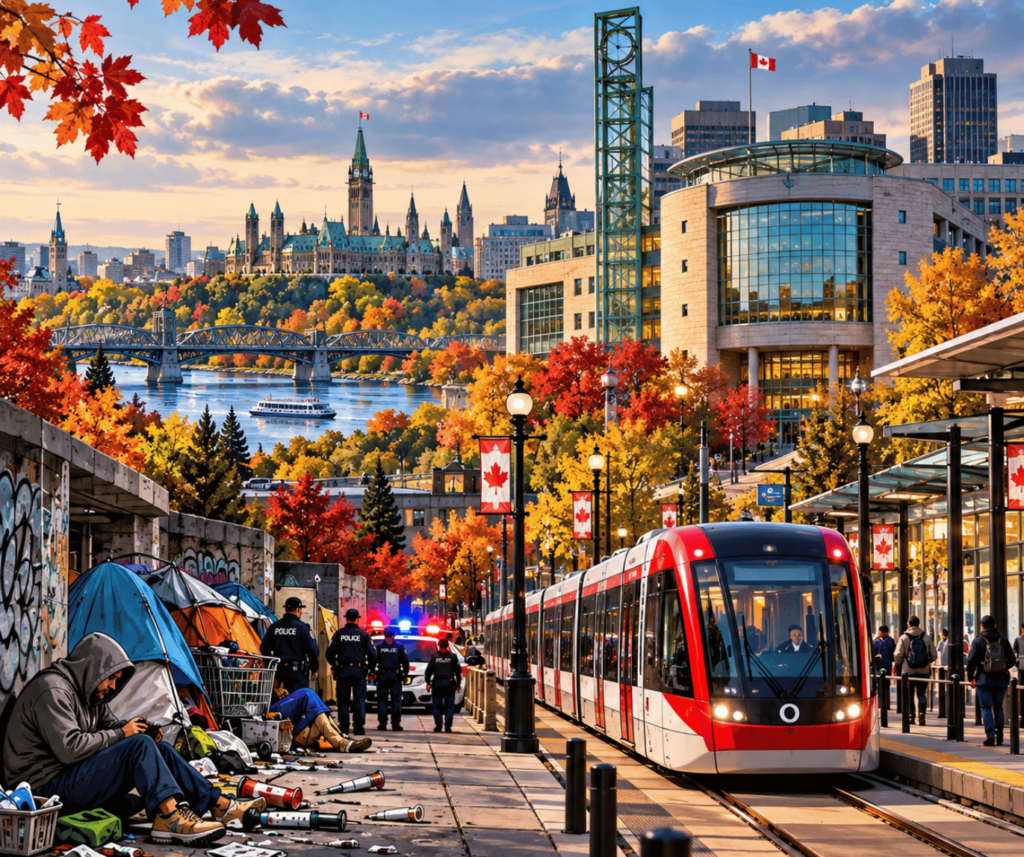
Crime and homelessness in downtown Ottawa are two of the most pressing issues in the mayoral campaign. As one long-time Ottawa resident told CBC about the situation on downtown Ottawa’s famous Rideau Street: “The guy that sits by the liquor store and shoots up dope in front of little children. Police drive by and nothing happens. That’s wrong.” (CBC article of 8 September 2016, “What do Ottawa voters want from City Hall? Here’s what they’re saying.”)
Downtown Ottawa resident and journalist Rupa Subramanya has been a frequent critic of conditions in the city’s central core, where Parliament and many federal government offices are located. Her ongoing commentary on central Ottawa, mostly found on her X/twitter account @rupasubramanya, makes for interesting reading and provides disturbing testimony as to what is going on.
A “shameful” way to run a G-7 capital city
Subramanya has frequently criticized Sutcliffe for the “lawlessness he’s presiding over in Ottawa” noting that it was “Shameful that [Deputy Mayor Stéphanie Plante] @PlanteSteph613 @_MarkSutcliffe are in charge of running a G7 capital.”
In August 2023, she referred to her downtown neighbourhood as “Ottawa’s Skid Row” and noted that staff at the Department of National Defense had to be relocated from a downtown office building after employees were “verbally and physical accosted.”
On August 16, 2023, Subramanya tweeted: “My neighbourhood Rexall in downtown Ottawa is closing. The owner can’t keep up with weekly thefts amounting to nearly $8,000, rent going up, and a crime and drug infested downtown core where the drug dealers and addicts have taken over. A microcosm of life in a Canadian city.”
Later, in January 2026, Subramanya noted that downtown Ottawa was “increasingly becoming unsafe and, just a block or so from Parliament it was “becoming increasingly unsafe to live in my Ottawa neighbourhood, just steps from Parliament, a shameful state of affairs for a G7 capital.”
Drug use, public urination, knife fights
As recently as June 2026, she posted photos of a nearby homeless encampment and criticized Ottawa police, as well as Sutcliffe and city council, over what she described as a failure to enforce existing rules against disorderly behaviour and unauthorized camping. “[The] disorder in the encampment keeps growing,” she wrote. “They’ve got couches now. There’s drinking, drug use, public urination, and there was a knife fight the other day.”
Subramanya has further noted that “before the camp expanded, on the day of the knife fight, I asked an officer parked beside it why the no loitering rule wasn’t being enforced.” Subramanya says she asked an officer if she would be able to “bring a bunch of people over and camp out in the same spot and engage in disorderly behaviour” and, according to her account, the officer said “the police don’t have the resources to enforce the rule of law and that if I wanted to report the encampment, I’d have to call the police. Apparently the officer sitting in a police cruiser, next to the encampment, with a computer in front of him, wasn’t able to do that.”
I remember downtown Ottawa quite differently. During my four years as an MP, from 2011 to 2015, I lived and worked in the downtown core roughly four days a week for about eight months of the year. I found it highly walkable and felt safe walking its streets. There were certainly homeless people living on the streets, and I occasionally encountered someone asking for spare change, but the city was generally quite calm – even a bit “sleepy.” Clearly, things have deteriorated over the past 15 years, and the downtown Ottawa I knew is not the downtown Ottawa of today.
How did this happen? And, perhaps more importantly, when? Voters need to ask: have the last four years of Mayor Sutcliffe’s mayoralty contributed to the city’s downward spiral into the level of disorder that Subramanya so vividly describes today?
Other issues include transportation and rapid growth
There are other important issues facing Ottawa including the transportation debacle that took place under the watch of Mayor Watson and his endorsed successor, Sutcliffe. Most spectacular among the many transportation messes is what CBC journalist Elyse Skura called “the catastrophic launch of the east-west LRT and the pandemic cratering of ridership levels” that left OC Transpo struggling to regain the trust of riders.
Then there are the challenges of rapid growth, a problem facing many of Canada’s large and medium-sized cities. As Ottawa resident Kayla Kirkbridge told the CBC in September, “The population is just growing and growing… The traffic is just becoming more and more of an issue.” (CBC, 8 September 2026).
And the latest polling suggests that transportation is not just a campaign talking point – it is Ottawa voters’ top concern. A September ElectRight poll found that 31% of respondents identified fixing public transit as the top priority for the next mayor, followed by keeping property taxes low at 17% and public safety at 14%.
Stay tuned for more on Ottawa
I plan to take a closer look at Ottawa’s transportation and growth challenges in an upcoming Municipal Watch article.