
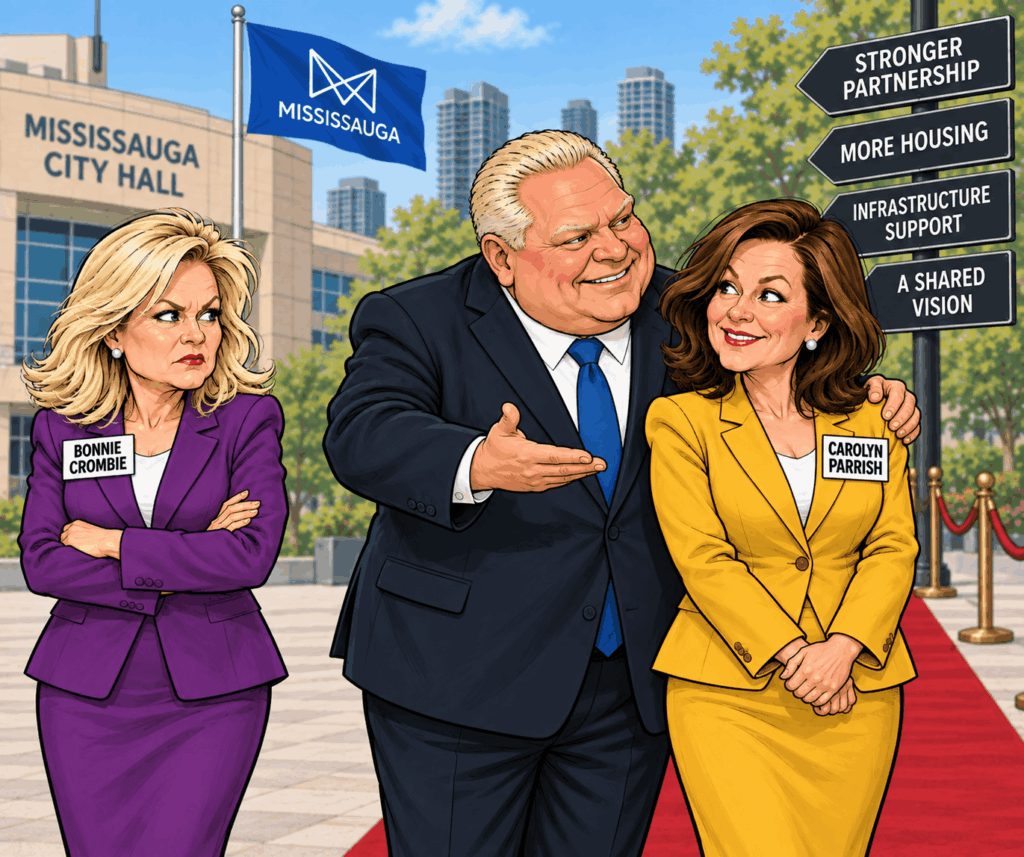
Municipalities may be creatures of the province, but should the Premier get to play kingmaker at City Hall? That’s the question worth asking as Mississauga – one of Canada’s largest cities, with roughly 770,000 residents – heads toward its mayoral election.
Because Premier Doug Ford has made his preference pretty clear.
Ford wasn’t a fan of Bonnie Crombie even before she became Liberal leader and his opponent in the 2025 provincial election. When she was mayor of Mississauga, Crombie fought Ford’s government over development charges – the fees paid by developers to help fund the infrastructure required to service new residents. Lowering those charges prompted Crombie to ask a fairly straightforward question: if developers pay less, who makes up the difference, and do existing taxpayers end up carrying more of the cost?
Hey, Mayor! “Stop the whining and complaining!”
Ford’s response to Crombie was not exactly diplomatic. He told her to “stop the whining and complaining.”
Ford’s interaction with current Mayor Carolyn Parrish on this issue was quite different. Instead of calling her names, just last week, he (together with representatives from the federal government) handed her a cheque in the sum of up to $401.4 million for the City as part of the Development Charges Reduction Program – to pay for that infrastructure that is required and used to be paid for by development fees.
This isn’t a new alliance. In March of this year, at an announcement in Mississauga, Ford was even clearer about whom he wanted to see back in the mayor’s chair, declaring: “I will send an army down here to make sure I support Mayor Parrish.”
Ford: “I never get involved in municipal elections.”
There is something almost amusing about the sentence that preceded Ford’s militaristic declaration, which was: “I never get involved in municipal elections.” Apparently Mississauga is an exception. I doubt Crombie is shaking in her boots, however. According to a recent Liaison Strategies poll, voters were asked how Ford’s endorsement would affect their vote, and 39% said it would make them less likely to vote for Ford’s preferred candidate, while only 15% said it would make them more likely.
That’s quite a gap, and perhaps a useful reminder that a Premier’s endorsement isn’t necessarily the political gift he might imagine it to be.
And Then There Is Bill 100 (Doug Ford’s power grab)
There is a provincial issue where Crombie and Municipal Watch happen to find themselves on the same side. She and I don’t agree on very much but, on Doug Ford’s Bill 100, which I wrote about last month (https://municipalwatch.ca/2026/07/29/from-for-the-people-to-power-for-the-premier/), we do.
Crombie has expressed opposition to the legislation, which gives the Premier the power to appoint regional chairs and then gives those appointees sweeping “strong chair” powers. The obvious concern is that a chair appointed by the Premier could potentially veto or override decisions supported by a democratically elected council.
That is a pretty extraordinary transfer of local political power to Premier Ford himself.
And it is worth noting because this is exactly the kind of issue Municipal Watch has been warning about: whatever one’s political allegiance, it is fundamentally undemocratic to give the Premier the power to appoint the leader of a regional government and then giving that Premier (Ford, and all those who come after him) enhanced powers over the elected council.
No more foreign flags at City Hall in Mississauga
Mississauga is a fascinating municipal case study because it sits at the intersection of so many of the debates currently reshaping Canadian cities. It is growing, its population is extraordinarily diverse, its housing needs are changing, its neighbourhoods are changing, and residents are clearly thinking about whether the city is headed in the right direction.
The foreign flag issue threw the curtain open on Mississauga’s changing relationship with its own multicultural identity. For years, the city has worn its diversity proudly and made cultural recognition a prominent part of civic life. But the politics surrounding some of that recognition have become considerably more complicated.
There were incidents around foreign flag raisings at Mississauga’s Celebration Square for Pakistan Day and India’s Independence Day that exposed some of the tensions beneath the city’s famously multicultural surface. Online, there were comments condemning the countries themselves as well as insults directed at residents of their respective Mississauga communities. City officials described some of the comments as “misinformed and even hateful,” while acknowledging that much of the online criticism was directed more broadly at the practice of raising foreign flags.
No more “national colours” or “lights” either
Things became contentious enough that when Calgary City Council voted in December 2025 to end the raising of foreign national flags at City Hall, Mississauga soon followed. In April 2026, Council unanimously approved Mayor Carolyn Parrish’s call to remove national flag raisings from Mississauga’s city square. Even “displays of lights associated with national colours (with the exception of those of Canada) on the civic centre clock tower” were banned.
The foreign flag issue also represents a striking contrast between the two frontrunner candidates. As mayor, Crombie had championed the City’s Community Recognition Program (under which the foreign flags are flown) as a way of celebrating the city’s cultural diversity; in 2026, Council headed up by Mayor Parrish passed a motion banning foreign-flag raisings, describing them as a source of “controversy and at times division within the community.” Parrish herself called the practice “very controversial” and said she was no longer prepared to continue it.
The flag controversy is interesting not because any flag, by itself, is going to determine who becomes mayor. It won’t. It is interesting because it illustrates something broader happening in Mississauga: the old assumptions about what multiculturalism looks like, and how City Hall should handle it, are running into growing pushback from residents themselves.
In addition to the debate over foreign flags, the Ridgeway Plaza controversy is another manifestation of those tensions. Arguments over development charges, density, transit and municipal autonomy are others. And now the mayoral race itself is testing whether Mississauga voters want to continue in the direction the city has been heading – or whether they are ready for a change.
That is why Canadians who don’t live in Mississauga should pay attention.
Municipal politics is where big national and provincial arguments eventually become local and very personal. Immigration, for example, eventually becomes a question about how a neighbourhood changes. Multiculturalism becomes a question about how public space is used. Housing policy becomes a question about whether you can still afford your home. Provincial power becomes a question about who gets to make decisions at City Hall. And “safety” stops being an abstract campaign talking point and becomes a question about whether residents feel comfortable walking down their own street at night.
Mississauga’s voters will decide which version of their city they want. The rest of us can learn something by watching what they decide, because the issues playing out there aren’t particularly unique to Mississauga. They’re showing up in cities across the country, in different forms and with different political personalities attached to them.
What Kind of Change do Mississauga Voters Want?
And perhaps that’s what makes this race so interesting. The question isn’t simply who will win. It is what, exactly, are Mississauga voters trying to change? And what do they think needs to be preserved?
Because when 46% of residents say their city is moving in the wrong direction, and 45% say it is less safe than it was a year ago, there is clearly a story here.