
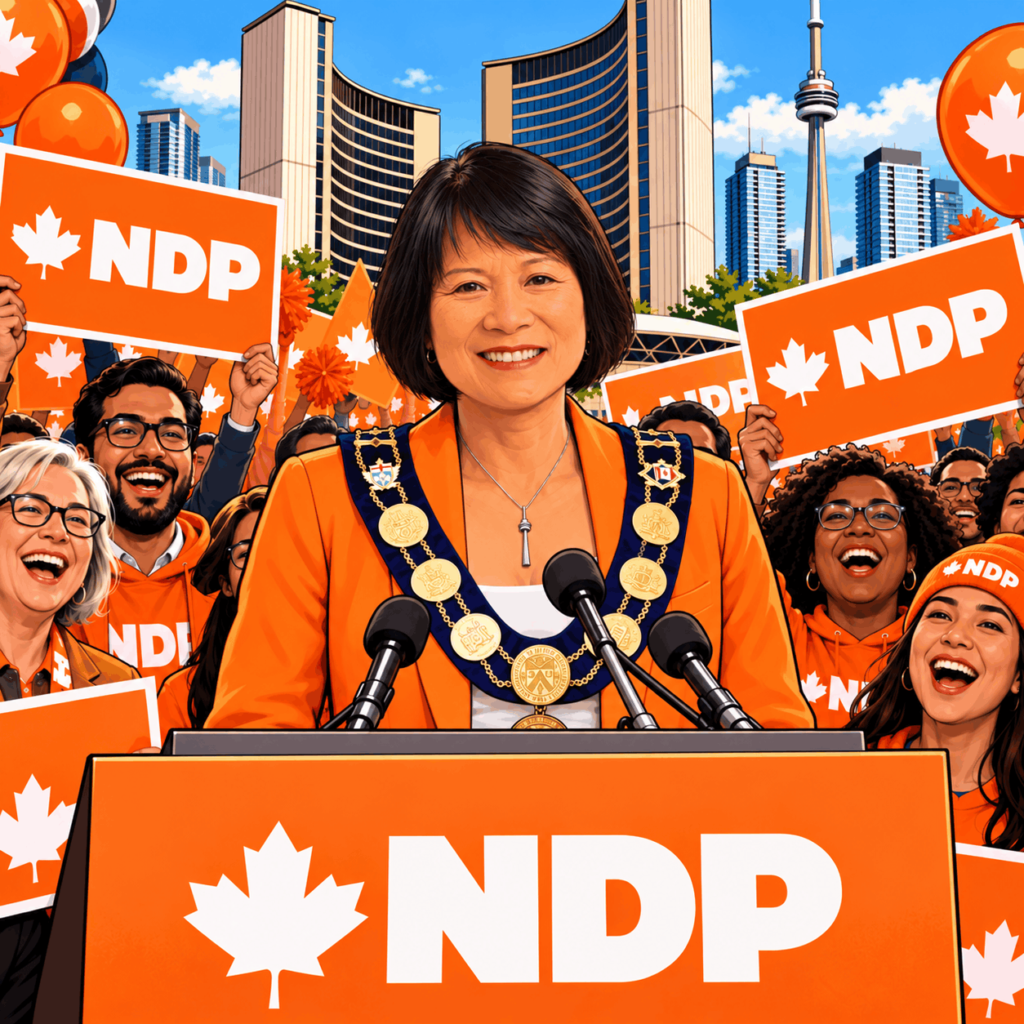
Olivia Chow has been a fixture in Toronto politics for a very long time. Her career stretches back decades, from the local school board to Toronto City Council and eventually to Canada’s Parliament. Her history tells us a lot about the politician now running Canada’s largest city.
She was first elected as a Toronto Board of Education trustee in 1985. In 1991, she moved to Metro Toronto Council, becoming the first Asian-born woman elected to that body. After the amalgamation of Metro Toronto’s seven municipalities on January 1, 1998, she served on the new Toronto City Council, winning election in 1997, 2000 and 2003. In total, she spent 14 years in local politics before leaving City Hall in 2005 to pursue federal office.
In 2006, she was elected as the NDP Member of Parliament for the downtown Toronto riding of Trinity-Spadina and was re-elected in 2008 and 2011. She held the seat until 2014, when she resigned as MP to run for mayor of Toronto.
Chow was married to Jack Layton, one of Toronto’s most recognizable political figures. For his part, Layton also spent decades in Toronto municipal politics, as a city and Metro councillor before becoming leader of the federal NDP in 2003. He was elected MP for Toronto-Danforth in 2004 and became Leader of the Official Opposition after the May 2011 federal election. He died a few months later, in August 2011.
By 2014, Chow had spent nearly three decades in elected politics.
That year, she decided to make the jump from Parliament back to City Hall, this time aiming for the mayor’s chair.
John Tory won that election with about 40 per cent of the vote. Doug Ford finished second with almost 34 per cent and Chow came third with just over 23 per cent.
Nine years later, she got another shot.
Second Time’s A Charm
In October 2022, John Tory was re-elected to a third term with about 62 per cent of the vote. Just a few months later, he resigned after acknowledging an inappropriate relationship with a former member of his staff – a relationship that began during the COVID-19 pandemic, while Tory was publicly urging Toronto residents to practise “social distancing.”
His resignation took effect on February 17, 2023, and that triggered a mayoral by-election.
Chow ran again and this time she won, receiving 37.2 per cent of the vote and beating Ana Bailão, who received 32.5 per cent. Mark Saunders was a distant third at 8.6 per cent. An array of “also rans” accounted for the remainder 20-plus per cent.
Here’s an interesting footnote: Brad Bradford, who is now her principal challenger, was one of those “also rans.” He finished eighth, with just 1.28 per cent of the vote.
But winning the mayor’s chair is one thing. What did Olivia Chow actually do in her first two-plus years as mayor? To answer that, we need to look beyond the campaign trail and examine her record – the decisions she has made, the priorities she has pursued, and what they tell us about the mayor she is today and the direction she wants to take Toronto next.
The next two parts of this series will take a closer look at Chow’s record in office, as well as the key themes shaping the campaign of her leading challenger. But before we get too far into the present, it is worth looking back a few decades. Because if we’re going to examine Chow’s political record, we would be remiss not to revisit one of the earlier controversies that helped define her political career and, at the time, became something of a scandal involving both Chow and her husband, former NDP leader Jack Layton.
Do as I Say, Not as I Do?
In the mid 1980s to early 1990s, Chow and Jack Layton, lived in a federally subsidized housing co-operative while both were well-paid elected officials.
Here were two prominent politicians whose careers were closely tied to social justice, affordable housing and government intervention, living in a federally assisted housing co-operative despite having a combined income far above that of many of the residents the system was intended to help.
Technically, the arrangement was within the rules. But the optics were terrible.
This wasn’t a case of Chow and Layton secretly occupying a rent-geared-to-income apartment while pretending to be low-income tenants. But it did raise an uncomfortable question: should elected officials with relatively high incomes participate in taxpayer-assisted housing programs, even when the rules technically allow them to do so?
The episode highlighted a potential gap between political principle and personal practice – advocating government programs designed to help those with fewer resources while benefiting from one themselves.
It is an old controversy but that doesn’t necessarily make it irrelevant. It calls into question her overall judgement and provides an early glimpse into a question that has followed her political career for decades: how closely do the principles she advocates for others align with the choices she makes herself?
That question brings us back to the present.
Olivia Chow has spent decades in politics, as a school trustee, councillor, MP and now mayor. Along the way, she has built a very solidly NDP, left-wing political identity.
That’s not been a secret. But what happens when that ideology meets the messy realities of governing a city?
In Part Two, we’ll take a closer look at Chow’s record as mayor, including some of the notable flip-flops of her first term, and see how her closest competitor stacks up.