
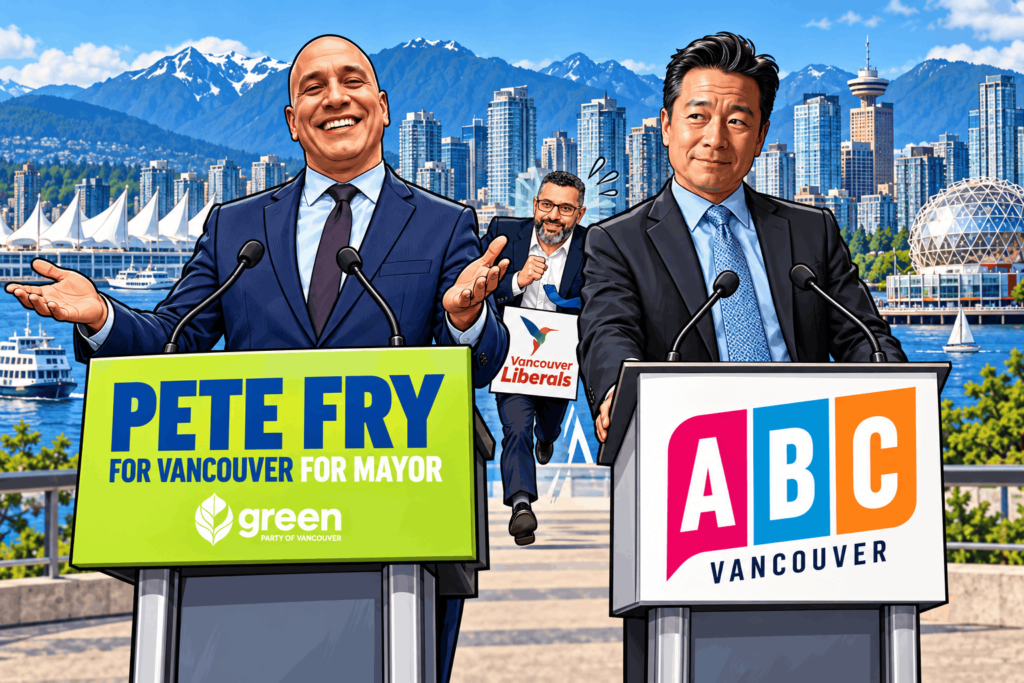
The race for Vancouver mayor is down to the wire, as they say. The latest public opinion poll, released October 9, was conducted between September 28 and October 6 by Canada Pulse Insights, the polling firm headed by veteran pollster John Wright. Commissioned by CityNews and OMNI TV, the survey polled 500 Vancouver residents.
The poll puts Green Party candidate Pete Fry at 28% of decided voters, narrowly ahead of incumbent Mayor Ken Sim, of Vancouver’s centre-right ABC Party, at 27%.
With a margin of error of plus or minus 4.4 percentage points, the one-point gap amounts to a statistical tie. But, according to Wright, the two candidates draw support from voters with distinctly different priorities. Fry’s supporters, he says, tend to be more focused on “the environment, more on ethics, more on accountability, more on affordability, more on housing.”
Mayor Sim’s supporters, who account for 27% of decided voters in the poll, form a coalition with a different set of priorities. “Affordability is the most important issue to them, but then it’s crime, it’s municipal taxes, it’s accountability for the bottom line; they’re more meat-and-potato issues,” Wright observed. He added that these concerns tend to motivate people to vote, particularly older voters who own homes and pay property taxes.
It’s interesting that affordability ranks among the top concerns for the coalitions backing both front-runners. Vancouver voters need only look to the recent example of Mayor Sim’s sensible advocacy on the previous mayor’s natural gas ban policy for a clear indication of which candidate will best address the cost-of-living pressures they face.
As I argued in my June column, Mayor Ken Sim’s successful effort to roll back former mayor Gregor Robertson’s green fantasy of a natural gas ban was a victory for affordability and common sense. After trying unsuccessfully in 2024, Sim succeeded in May 2026 in reversing Robertson’s anti-natural gas policies, recognizing that “ideological climate policies were colliding head-on with economic common sense.” In a city long known for layering costly climate regulations onto housing construction – and where housing costs rank among the most unaffordable in the world – it was a victory for common sense and energy affordability in Vancouver. ABC councillors voted in favour of the reversal, while Green Party and other progressive councillors voted against it. Kudos to Sim for accomplishing this feat!
Pete Fry was among those opposing the successful reversal. In 2024, he called the decision “infuriating” and “a sad day for Vancouver”; in 2026, he again voted against Sim’s motion, accusing ABC of undermining climate policy. And Fry’s Green Party platform proposes to “re-establish policies to ban fossil gas heating for heat and hot water in new construction.” Having rolled back this potentially disastrous, anti-natural gas agenda, Vancouver cannot afford to ignore the possibility of its return. Fry’s comments and his party’s stated platform offer a clear warning: voters should be wary of those seeking to revive similarly reckless, costly, and irresponsible policies – policies that could come roaring back if Fry wins the mayoralty.
Kareem Allam: The Wild Card?
Several other candidates registered notable support in the recent Canada Pulse Insights poll: Kareem Allam of the Vancouver Liberals at 19%, Colleen Hardwick of TEAM for a Livable Vancouver at 13%, and Rebecca Bligh of Vote Vancouver at 7%.
Allam, in particular, deserves a closer look. He has run a high-profile campaign and, at 19%, sits well ahead of the other candidates outside the two front-runners. Could he emerge as a serious contender? His support makes him one of the more intriguing wild cards in a crowded and unpredictable race.
Allam managed Ken Sim’s successful 2022 mayoral campaign and briefly served as his chief of staff before being fired in February 2023. Allam subsequently accused Sim of being stopped by police for impaired driving, an allegation Sim denied. Sim was cleared by the Office of the Police Complaint Commissioner and filed a defamation lawsuit against Allam in May 2025. The case remains unresolved.
But what should interest Vancouver voters isn’t the dispute between Sim and Allam, but Allam’s left turn. A former supporter of the Canadian Alliance, the federal Conservatives and the provincial BC Liberals, Allam backed Sim and the centre-right ABC slate in 2022. Yet after Sim fired him in February 2023, Allam accused the mayor of taking a “hard right turn.” The more striking shift, however, has been in Allam’s own politics.
When the BC United Party collapsed in 2024, many of its former supporters gravitated toward John Rustad’s BC Conservatives. Allam went the other way, making an enthusiastic and very public leap to the NDP in a closely fought provincial election. In an October 2024 interview with The Tyee, titled “Why a Key BC Liberal Strategist is Voting NDP,” he explained: “I’m not sure that I left the centre-right movement. I think the centre-right movement left me.” Allam cited climate action, Indigenous reconciliation, SOGI and supervised consumption sites as reasons he felt aligned with David Eby’s NDP.
Then came the de rigueur Trump argument. Allam declared, “Trump politics is now here in BC, and it’s terrible. It’s embedded. It’s entrenched.” It’s a familiar refrain among former centre-right figures who move left, portraying common-sense conservative positions as extreme rather than principled differences over policy. For Vancouver voters, the question is whether Allam’s new political home reflects a genuine change in outlook and how closely his priorities align with the NDP agenda he now supports.
Ultimately, the choice facing Vancouver voters comes down to two very different visions for the city: radical left-wing Green Party candidate Pete Fry and sensible centre-right incumbent Mayor Ken Sim. The race is neck and neck, and Vancouver’s future hangs in the balance.
Municipal election day in British Columbia is Saturday, October 17, 2026.