
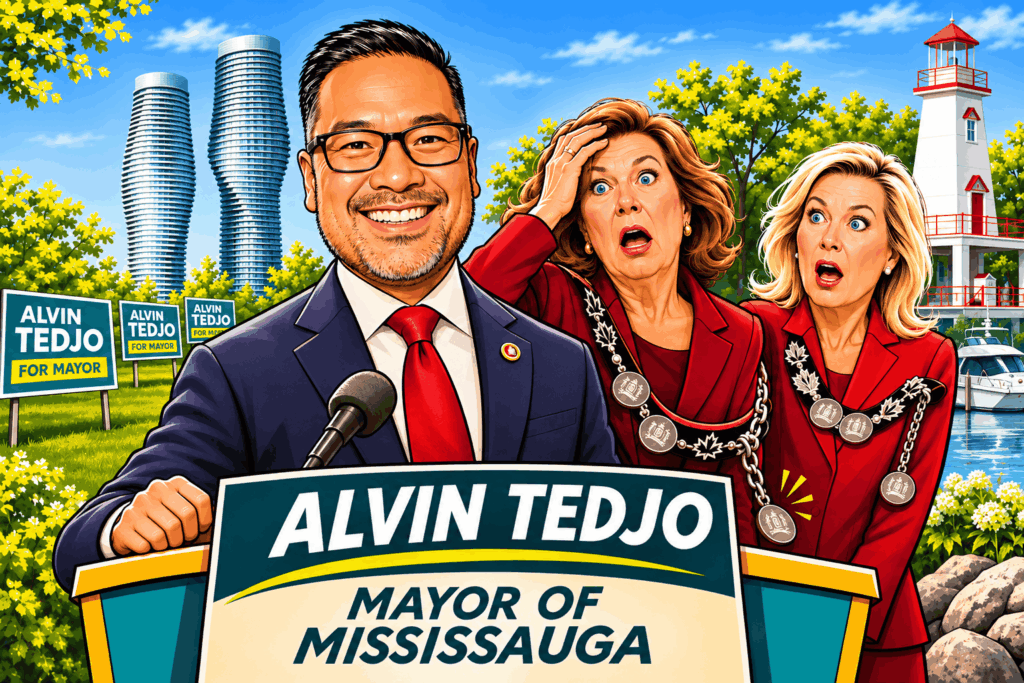
Of all the results on election night, October 26, one stood out as the biggest shocker for me personally: Alvin Tedjo’s decisive victory in Mississauga.
I know the city well, having represented Mississauga in Parliament as an MP for a term, and I have followed its municipal politics for years. But I certainly didn’t see this coming. A relatively unknown, one-term city councillor handily defeated not one, but TWO former mayors – both seasoned political veterans, both with considerable name recognition, and both with years of experience at the municipal level.
One was the incumbent, Carolyn Parrish, who had served on council for years before becoming mayor. The other was Bonnie Crombie, who had occupied the mayor’s chair for almost a decade, winning three consecutive elections by increasingly impressive margins.
Tedjo beat them both, capturing 74,479 votes (38.9%), compared with Parrish’s 51,853 (27.1%) and Crombie’s 43,191 (22.6%). That’s a decisive victory over two politicians who are two of the city’s best-known names in Mississauga municipal politics.
What happened? How did a relative newcomer manage to upend two political heavyweights? And what does this result tell us about what Mississauga voters were looking for?
The polar opposite in neighbouring Brampton
For an interesting comparison, look just up the road to Brampton, where the result was almost the polar opposite.
Incumbent Mayor Patrick Brown sailed to a third consecutive term, securing 65,893 votes, or 54.9 per cent. His nearest challenger, Wesley Jackson (who also ran against Brown in 2018) managed 23,236 votes, or 19.4 per cent. Brown won every ward and finished first at every poll.
He barely broke a sweat.
And his election-night message was interesting. Brown talked about building, teamwork and working with other levels of government. In his victory speech, he described a city united behind what he called the “big Brampton build,” pointing to investments in recreation, health care and transportation. He emphasized a united team at the municipal, provincial and federal levels, working together to build the city.
That message stands in considerable contrast to the one which unfolded in Mississauga.
Building was much less of a defining campaign issue there. Bonnie Crombie talked about building a subway to Mississauga, but the proposal landed more like a pie-in-the-sky fairy tale than a genuinely visionary policy proposal.
Mississauga is building things, to be sure. The controversial Hurontario LRT is an enormous undertaking, but it has been years in the making and continues to make life difficult for residents, businesses and commuters, with the end of this still-controversial project not quite in sight.
Perhaps the explanation lies in the very different challenges facing two cities at different stages of maturity.
The Hazel McCallion legacy
When the legendary Hazel McCallion was mayor, building was the order of the day. Mississauga grew by leaps and bounds, year after year. New subdivisions, roads, shopping centres and commercial developments seemed to spring up everywhere. Growth was the city’s defining characteristic, and Hazel was the mayor who presided over it.
She was also an extraordinary political phenomenon. McCallion served as mayor for 36 years, winning 12 consecutive terms, before finally retiring at the age of 93 in 2014. Twelve terms! Thirty-six years! That’s a municipal political run that is almost impossible to imagine today.
Of course, not everyone admired her approach. Critics have long argued that McCallion didn’t so much manage growth as allow it to run wild. Whatever one’s view, there is no denying that she presided over a remarkable transformation of Mississauga.
But eventually, the easy growth years came to an end. There were fewer open fields to develop, fewer opportunities for massive housing subdivisions, and a changing economic landscape. The mayors who followed inherited a very different set of challenges.
Instead of overseeing explosive growth, they were left playing catch-up with the infrastructure and service demands of a city that had grown faster than a toddler racing toward an open staircase. Roads, transit, recreation facilities and other municipal services all needed attention and money.
And money, of course, usually means higher taxes.
Crombie, who succeeded McCallion in 2014, and Parrish, who succeeded Crombie in 2024, inherited those more traditional, less glamorous municipal challenges. Both are seasoned politicians and former Liberal MPs, and neither appeared particularly reluctant to turn to annual property-tax increases to help pay for the city’s growing list of needs.
Needless to say, residents don’t always appreciate the direct line from the growth that makes a city prosperous to the bills that eventually arrive to service it.
Building a new city is exciting. Paying to maintain one is considerably less so.
The “team” approach: easier said than done in Mississauga
Brown’s emphasis on teamwork and cooperation with other levels of government is another interesting contrast.
Certainly, one can imagine Tedjo working comfortably with the federal Liberal government under Mark Carney. But municipal opportunities to work directly with Ottawa are relatively limited. Municipalities are creatures of provincial legislation, and their relationship with the provincial government is deeply embedded into virtually every aspect of municipal business.
That makes the relationship between a mayor and the premier particularly important.
Ford and Parrish appeared to have a reasonably workable relationship during her almost two-and-a-half years in office. The same certainly could not be said of Ford and Crombie. Their political relationship was openly hostile, with Ford calling her 2014-2024 mayoralty “an absolute disaster” and famously vowing in March to send an “army” to defeat her during her campaign for Mississauga mayor.
There’s a certain irony here when it comes to Patrick Brown. Had he not been unceremoniously dumped as leader of the Ontario Progressive Conservatives in January 2018, he might well have been the man leading the province today. Instead, he bounced back quickly, registering to run for mayor of Brampton that same summer.
Eight years later, he has built an impressive political following and secured a third consecutive mayoral victory with nearly 55 per cent of the vote. His relationship with Ford’s PC government is now considerably more constructive than the one Crombie had with the premier.
It’s a reminder that municipal leadership isn’t just about what happens inside City Hall. The ability to work with the province, even where there are political or personal differences, can have a very real bearing on what a mayor can accomplish.
Bonnie Crombie: From political powerhouse to third place
Bonnie Crombie was a familiar, recognizable and, until recently, extraordinarily popular political figure in Mississauga. Elected mayor in 2014, succeeding Hazel McCallion, she went on to win three consecutive elections by increasingly impressive margins:
- 2014: 63.5 per cent of the vote.
- 2018: 77 per cent.
- 2022: Nearly 80 per cent.
After almost a decade at City Hall, she left municipal politics to pursue the leadership of the Ontario Liberal Party. That venture ended rather spectacularly: she led her party to defeat in the 2025 provincial election, failed to win her own seat and subsequently stepped away from the leadership. (In another rather bizarre twist, she lost her local MPP campaign to Patrick Brown’s mother-in-law!)
She eventually returned to municipal politics, presumably believing that her decade of experience and established popularity in Mississauga would give her a solid foundation. Of course, political comebacks always carry risks, and she was hardly returning from a position of strength.
So, it wasn’t necessarily her defeat itself that was surprising. It was the fact that she finished third, with just 22.6 per cent of the vote – particularly when the final two polls before election day had her leading the race.
Anecdotally, I heard some suggest that voters weren’t particularly impressed with her decision to return to Mississauga after losing at the provincial level. Perhaps there was a perception that City Hall was a consolation prize or a comfortable fallback position. But that’s speculation, and it doesn’t really answer the more relevant question: Why did so many voters choose Tedjo instead?
Who IS Alvin Tedjo?
On election night, watching the television coverage, it was almost amusing to see commentators scrambling to figure out who this Alvin Tedjo fellow was, as his name appeared at the top of the results and stayed there throughout the evening.
I was guilty of the same oversight myself. Having written no fewer than THREE Municipal Watch articles about the Mississauga mayoral race, I managed to mention Tedjo only once!
I do know him. Tedjo represented Ward 2, a ward that was part of my former federal riding of Mississauga South, and, as it happens, the ward in which I lived. He was elected to council in 2022 and was serving his first term when he decided to run for mayor.
He wasn’t completely unknown, then, but his profile was certainly nowhere near that of either Parrish or Crombie.
And yet, he managed to pull off a convincing victory.
In fairness, the polls had been signalling that something was happening. Tedjo was running a respectable third for much of the campaign, but two polls released just days before election day showed him moving into second place.
A Liaison Strategies poll released October 22 put Crombie at 35 per cent, Tedjo at 31 per cent and Parrish at 28 per cent among decided and leaning voters. An Abacus Data survey, commissioned by the Tedjo campaign, put Crombie at 31 per cent and Tedjo at 28 per cent, with Parrish at 27 per cent.
Both polls had Crombie in the lead and both underestimated Tedjo’s eventual support, which reached 38.9 per cent.
The warning signs were there, but clearly not everyone was paying attention – myself included!
Did voters simply have enough?
I wish we had exit polls in Canada, and for municipal elections in particular, because the Mississauga result cries out for a little more explanation.
Did voters simply have enough of veteran politicians who seemed more interested in taking potshots at one another than explaining what they intended to do for the city?
The campaign between Parrish and Crombie became increasingly personal, and, at times, downright nasty.
In an early October debate, Parrish referred to Crombie as the “blonde bombshell,” remarking that staff were “terrified” of her returning to City Hall.
Crombie, meanwhile, took aim at Parrish’s work ethic, accusing her of spending too much time behind her desk and not enough time out among residents. She suggested Parrish was a mayor who “just sits behind her desk” and “never leaves her office.”
Parrish fired back that she attended everything significant to the city, “not just in a pretty dress and dancing around in high heels.”
Ouch!
It was political theatre and it seems voters were not impressed.
A Liaison Strategies poll conducted October 2-4, immediately following the debate, found that 74 per cent of Mississauga residents considered personal comments or insults about other candidates unacceptable during an election campaign. Only 14 per cent described the campaign as mostly respectful, while 34 per cent characterized it as mostly mean-spirited.
And it wasn’t just supporters of one candidate expressing their displeasure. Rejection of personal insults was consistent across the supporter groups.
Perhaps voters were simply looking for a clean slate – someone who wasn’t carrying the baggage of years of municipal political battles, personal feuds and familiar faces taking turns bashing one another.
Tedjo offered that alternative.
It’s certainly a plausible explanation, but was his victory a positive endorsement of Tedjo himself, or was it, at least in part, a rejection of the two better-known candidates?
We may never know for certain.
A fresh face versus experience
Mississauga is a large, diverse city of nearly 800,000 people, with a municipal budget of approximately $2 billion. Running it is no small undertaking. There are complex infrastructure demands, housing pressures, transit challenges, economic development priorities and an enormous range of services that residents expect to work efficiently.
A relatively new councillor may bring fresh ideas, a different approach and a welcome change in tone. But there is also something to be said for having spent years navigating municipal government, understanding its machinery and building relationships with the people and institutions that make it work.
Tedjo now has to demonstrate that he can make that transition from councillor to mayor and that the fresh face voters chose comes with the leadership and judgment, if not the experience, needed to run one of Canada’s largest cities.
The honeymoon won’t last forever.
We underestimated you, Alvin!
One thing is certain: Mississauga voters delivered a message on October 26, and it was considerably louder than many of us anticipated.
The city’s political establishment has been shaken up. Two familiar political heavyweights have been sent packing, and a one-term councillor has been handed the keys to City Hall.
Was it a vote for change? A rejection of political infighting? A desire for a new generation of leadership? Or some combination of all three?
My guess is that it was D: all of the above.
And perhaps there’s a lesson here for municipal politicians elsewhere: name recognition, years of experience and a lengthy political résumé are no guarantee of voter loyalty. Nor is incumbency an insurance policy against public dissatisfaction.
Sometimes, voters just want something different. And sometimes, they are prepared to take a chance on someone they know considerably less about.
We underestimated you, Alvin.
Congratulations on your victory, and best wishes as you take on the enormous responsibility of leading Mississauga.