Vancouver mayor election 2026

A Close & Crucial Election for Vancouver Mayor

The race for Vancouver mayor is down to the wire, as they say. The latest public opinion poll, released October 9, was conducted between September 28 and October 6 by Canada Pulse Insights, the polling firm headed by veteran pollster John Wright. Commissioned by CityNews and OMNI TV, the survey polled 500 Vancouver residents. 

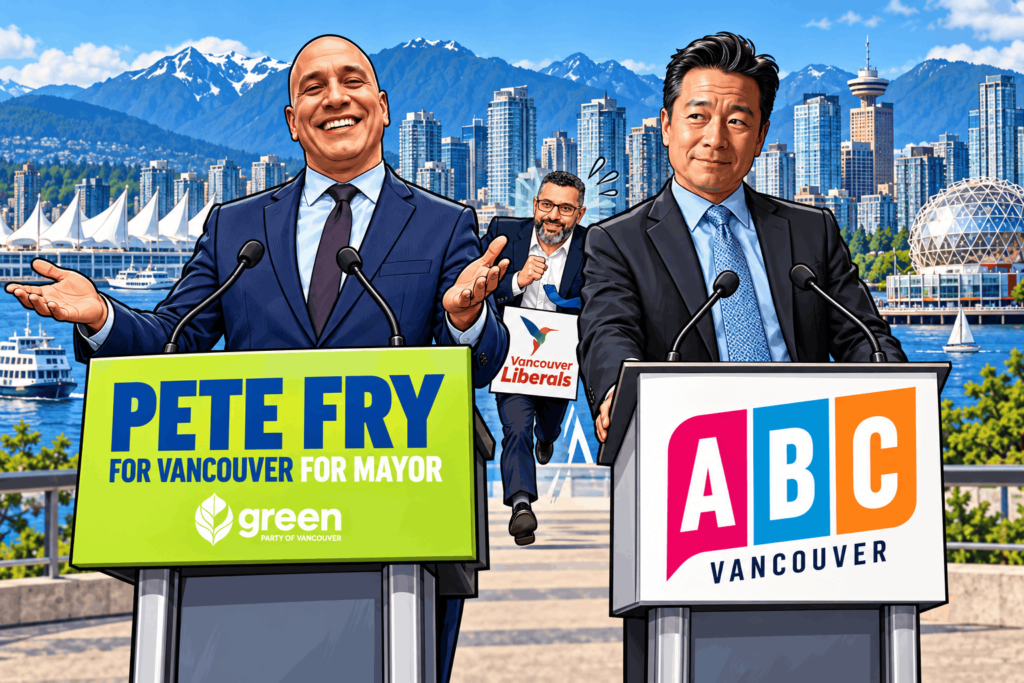
The poll puts Green Party candidate Pete Fry at 28% of decided voters, narrowly ahead of incumbent Mayor Ken Sim, of Vancouver’s centre-right ABC Party, at 27%. 

With a margin of error of plus or minus 4.4 percentage points, the one-point gap amounts to a statistical tie. But, according to Wright, the two candidates draw support from voters with distinctly different priorities. Fry’s supporters, he says, tend to be more focused on “the environment, more on ethics, more on accountability, more on affordability, more on housing.” 

Mayor Sim’s supporters, who account for 27% of decided voters in the poll, form a coalition with a different set of priorities. “Affordability is the most important issue to them, but then it’s crime, it’s municipal taxes, it’s accountability for the bottom line; they’re more meat-and-potato issues,” Wright observed. He added that these concerns tend to motivate people to vote, particularly older voters who own homes and pay property taxes.

It’s interesting that affordability ranks among the top concerns for the coalitions backing both front-runners. Vancouver voters need only look to the recent example of Mayor Sim’s sensible advocacy on the previous mayor’s natural gas ban policy for a clear indication of which candidate will best address the cost-of-living pressures they face.

As I argued in my June column, Mayor Ken Sim’s successful effort to roll back former mayor Gregor Robertson’s green fantasy of a natural gas ban was a victory for affordability and common sense. After trying unsuccessfully in 2024, Sim succeeded in May 2026 in reversing Robertson’s anti-natural gas policies, recognizing that “ideological climate policies were colliding head-on with economic common sense.” In a city long known for layering costly climate regulations onto housing construction – and where housing costs rank among the most unaffordable in the world – it was a victory for common sense and energy affordability in Vancouver. ABC councillors voted in favour of the reversal, while Green Party and other progressive councillors voted against it. Kudos to Sim for accomplishing this feat!

Pete Fry was among those opposing the successful reversal. In 2024, he called the decision “infuriating” and “a sad day for Vancouver”; in 2026, he again voted against Sim’s motion, accusing ABC of undermining climate policy. And Fry’s Green Party platform proposes to “re-establish policies to ban fossil gas heating for heat and hot water in new construction.” Having rolled back this potentially disastrous, anti-natural gas agenda, Vancouver cannot afford to ignore the possibility of its return. Fry’s comments and his party’s stated platform offer a clear warning: voters should be wary of those seeking to revive similarly reckless, costly, and irresponsible policies – policies that could come roaring back if Fry wins the mayoralty.

Kareem Allam: The Wild Card?

Several other candidates registered notable support in the recent Canada Pulse Insights poll: Kareem Allam of the Vancouver Liberals at 19%, Colleen Hardwick of TEAM for a Livable Vancouver at 13%, and Rebecca Bligh of Vote Vancouver at 7%.

Allam, in particular, deserves a closer look. He has run a high-profile campaign and, at 19%, sits well ahead of the other candidates outside the two front-runners. Could he emerge as a serious contender? His support makes him one of the more intriguing wild cards in a crowded and unpredictable race.

Allam managed Ken Sim’s successful 2022 mayoral campaign and briefly served as his chief of staff before being fired in February 2023. Allam subsequently accused Sim of being stopped by police for impaired driving, an allegation Sim denied. Sim was cleared by the Office of the Police Complaint Commissioner and filed a defamation lawsuit against Allam in May 2025. The case remains unresolved.

But what should interest Vancouver voters isn’t the dispute between Sim and Allam, but Allam’s left turn. A former supporter of the Canadian Alliance, the federal Conservatives and the provincial BC Liberals, Allam backed Sim and the centre-right ABC slate in 2022. Yet after Sim fired him in February 2023, Allam accused the mayor of taking a “hard right turn.” The more striking shift, however, has been in Allam’s own politics.

When the BC United Party collapsed in 2024, many of its former supporters gravitated toward John Rustad’s BC Conservatives. Allam went the other way, making an enthusiastic and very public leap to the NDP in a closely fought provincial election. In an October 2024 interview with The Tyee, titled “Why a Key BC Liberal Strategist is Voting NDP,” he explained: “I’m not sure that I left the centre-right movement. I think the centre-right movement left me.” Allam cited climate action, Indigenous reconciliation, SOGI and supervised consumption sites as reasons he felt aligned with David Eby’s NDP.

Then came the de rigueur Trump argument. Allam declared, “Trump politics is now here in BC, and it’s terrible. It’s embedded. It’s entrenched.” It’s a familiar refrain among former centre-right figures who move left, portraying common-sense conservative positions as extreme rather than principled differences over policy. For Vancouver voters, the question is whether Allam’s new political home reflects a genuine change in outlook and how closely his priorities align with the NDP agenda he now supports.

Ultimately, the choice facing Vancouver voters comes down to two very different visions for the city: radical left-wing Green Party candidate Pete Fry and sensible centre-right incumbent Mayor Ken Sim. The race is neck and neck, and Vancouver’s future hangs in the balance.

Municipal election day in British Columbia is Saturday, October 17, 2026.

Toronto’s Mayoral Flip-Flops: Olivia Chow and Brad Bradford

Toronto’s Mayoral Flip-Flops: Olivia Chow and Brad Bradford

Voters are rarely surprised by inconsistency in candidates for political office, even when they change opinions like chameleons. But Toronto’s 2026 mayoral race offers examples of flip-flops so spectacular, they deserve their own three-ring circus.

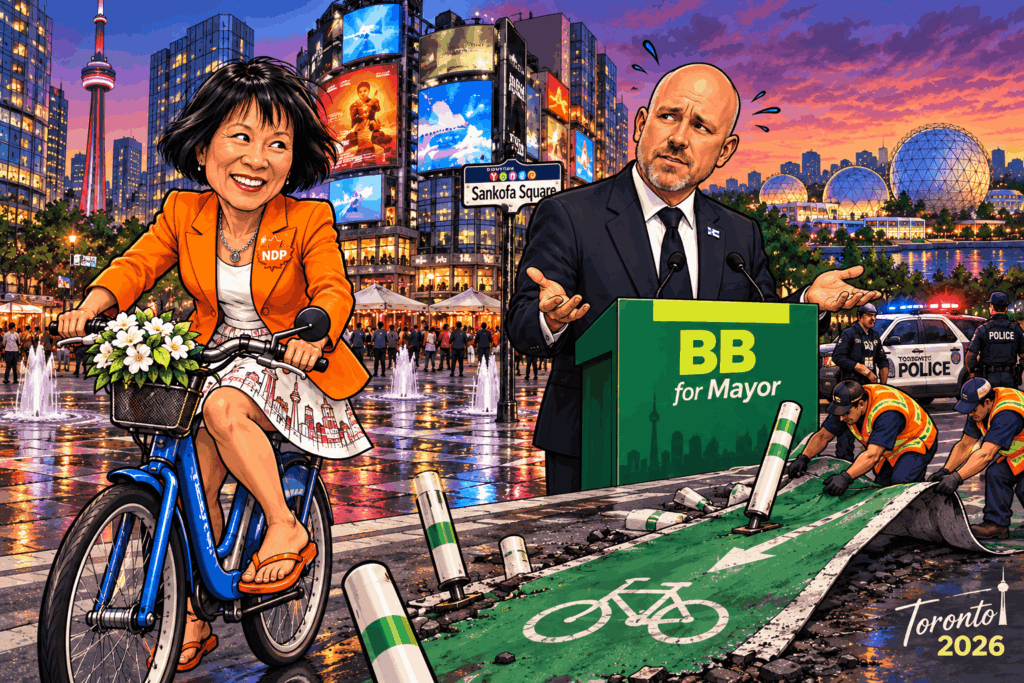
Here, we’ll look at four whiplash-inducing flip-flops by the two leading candidates for mayor, Olivia Chow and Brad Bradford: police funding, the Dundas name, bike lanes, and Ontario Place.

DEFUND THE POLICE, FUND MORE POLICE OFFICERS… which is it?

With public safety ranking among Toronto voters’ top concerns, the leading candidates’ records on policing deserve a close look.

Bradford’s most notable flip-flop dates to 2020, when he was one of eight councillors who voted for a 10% reduction in the police budget. He also supported a motion to disarm officers of some of their existing equipment.

But his position changed. During the 2023 mayoral campaign, he even argued that the city needed more police officers.

Bradford has since argued that his earlier position was about police reform and improving safety, and has pointed out that he subsequently supported the annual spending plans brought forward by the police chief.

Fast-forward to 2026 and Bradford is making public safety and law enforcement a central plank of his campaign, promising to hire 1,000 additional front-line officers during his first term.

Mayor Chow has been quick to point out Bradford’s 2020 vote.

“He wanted to defund the police … now he said he wants to hire police officers. I don’t know where he’s at,” she said.

Fair enough. But Chow’s own record on policing isn’t exactly a straight line either.

Upon election, she declined to take the mayor’s traditional seat on the Toronto Police Services Board. Instead, she appointed a designate, saying she wanted to focus on other priorities, including the city’s finances.

Her decision was not a violation of any rule, but it was politically significant. The mayor’s relationship with the police service is one of the clearest signals of how an administration approaches public safety.

Chow’s political history includes periods of (ahem) skepticism toward traditional policing, a charge to which she might respond that her emphasis is instead on social services and community-based solutions. 

Chow might also point to her support of substantial police budget increases, including more than $93 million in the 2026 budget, but one might wonder: has policing become a central priority for Chow, or is it something her administration supports when public pressure makes it politically unavoidable?

If one were measuring support for police by both candidates, a clear U-shaped curve would appear, with support peaking during election years!

So where does that leave us? Without a candidate who has a consistent position on what Toronto’s approach to policing should be, it seems.

Highways for Ontario Place

Few political flip-flops are as striking as Chow’s position on Ontario Place.

During the 2023 mayoral campaign, Chow strongly opposed the Ford government’s redevelopment plans, including the proposed massive bathing complex – with multiple saunas, huge soaking pools, several waterslides, and an indoor botanical garden (Therme).

Once elected, however, she negotiated with the province. In November 2023, Toronto and Ontario reached a deal under which the province would take control of advancing the Ontario Place redevelopment, while Toronto accepted the province’s authority to proceed. In return, Toronto secured significant financial support, including the provincial takeover of responsibility for two major city highways, the Gardiner Expressway and the Don Valley Parkway. 

In other words, the mayor who campaigned against the project ultimately negotiated a deal that allowed it to proceed. But the deal was only the tip of the iceberg.

Chow’s initial opposition wasn’t difficult to understand. For decades, Ontario Place had been a place where ordinary families could enjoy Toronto’s waterfront – a publicly accessible attraction rather than a luxury destination. The European spa concept throws a wrench into that vision.

In April 2025, the New York Times investigated Therme’s claims. The Times reported that Therme had presented itself as having experience with as many as six European facilities, while its investigation found that, at the time it was pursuing the Ontario Place deal, Therme itself had built and operated only one (in Romania). 

Ontario’s Auditor General had also raised a related concern. Its 2024 review found that Infrastructure Ontario had not adequately verified Therme’s claimed track record and that five of the six facilities cited by Therme were not owned or operated by Therme Group. (Therme subsequently purchased one of those facilities, reducing the number of facilities it did not own or operate from five to four.)

The Auditor General also criticized aspects of the procurement process, describing it as not fair, transparent or accountable.

Therme disputed the New York Times’ characterization and maintained that it had complied with the bidding requirements, but there are other questionable aspects of the plan.

Therme received a 95-year lease agreement for the Ontario Place West Island as well as a deal that requires the province to provide a parking facility with at least 1,800 spaces, including 1,600 dedicated to Therme and its guests. The price for that was originally estimated at an eye-popping $400 million, but the garage was eventually contracted for (only!) $198 million.

The Ontario Place story isn’t simply about a spa. It’s about a massive public redevelopment, a 95-year private lease, a controversial procurement process and a government assuming substantial infrastructure obligations around a private tenant.

Which brings us back to Chow.

The deal she negotiated with Premier Ford meant abandoning the principled opposition to Ford’s stinky Ontario Place deal that had been a central part of her 2023 mayoral campaign. And much was lost in the bargain.

Toronto no doubt needed the financial relief. But did Ontarians need a privately owned and operated luxury spa occupying a prime piece of publicly owned waterfront?

For those who believed Ontario Place should remain an affordable, accessible destination for families – a place to go, not a place most people could only look at from the outside – Chow’s decision to abandon her original opposition was a huge disappointment.

Sankofa Square: Toronto’s Woke Renaming Circus

The renaming of Yonge-Dundas Square offers another example of Chow’s approach to politically controversial issues: embrace the woke agenda, then retreat when the price tag becomes politically inconvenient.

The campaign to remove the Dundas name gained momentum after the 2020 Black Lives Matter protests. Critics argued that Henry Dundas, the Scottish politician after whom the street and square were named, had delayed the abolition of the transatlantic slave trade. Historians have disputed aspects of that interpretation, particularly the claim that Dundas opposed abolition itself. Rather, the record suggests that Dundas supported abolition, but through a more gradual approach.

During the 2023 mayoral campaign, Chow supported renaming all city infrastructure named after Dundas.

But when the cost of renaming Dundas Street was estimated at approximately $12-$13 million, she changed tack. Instead of proceeding with the full street renaming, a narrower proposal to rename Yonge-Dundas Square, along with two subway stations and a library, was passed.

Council voted 19–2 in favour of the change. Chow seconded the motion.

The result was Sankofa Square.

A Liaison Strategies poll conducted around the time found that 71% of respondents opposed the renaming of Yonge-Dundas Square.

But the city council, led by Chow, proceeded with a decision that many residents viewed as rushed, expensive and disconnected from their priorities.

Chow’s approach looked like an attempt to split the difference: acknowledge the woke activists’ concerns while avoiding the more controversial aspects of renaming an entire street. In other words, it was virtue-signalling, carefully calibrated to limit the financial and political fallout.

And what exactly was accomplished?

The city still spent money ($700,000 net so far by the city’s own estimates) changing signs, branding and public references. The historical debate surrounding Dundas was not resolved. And residents who opposed the change were left with the impression that their concerns mattered less than the symbolic demands of activist groups – the ones who support Mayor Chow.

Chow’s climbdown is less dramatic than Bradford’s complete about-face on this issue, though. 

Bradford was an enthusiastic supporter of all things Dundas-renaming in 2021, indicating a desire to move ahead in the process without delay and positioning the renaming as a step toward confronting systemic racism. As late as December 2023, Bradford was still on board, voting in favour of renaming the square, subways, library (but not the street, as council had backed off on that aspect by this time). 

At this stage, Bradford wasn’t merely going along with the process. He was publicly supportive of the underlying principle. 

Seven months later, in the summer of 2024, he put forward a motion to pause the entire renaming project, arguing that Toronto was broke and that the change wasn’t something the vast majority of Torontonians were asking for. He proposed redirecting money earmarked for new signage and marketing toward accessibility and safety improvements, but his motion failed.

And then Bradford decided he wanted to undo Sankofa Square altogether.

As a 2026 mayoral candidate, he proposed (in June) renaming it Toronto Square, while promising a major cleanup and a permanent police presence. 

So, on one of the most politically charged symbolic issues of the past five years, Bradford has gone from “pretty clearly no” to Dundas, to yes to Sankofa, to stop the spending, to let’s rename it again.

That’s quite a circular journey for one city square and one mayoral candidate!

Bike Lanes: Let Ford Take the Heat

Perhaps the most ironic flip-flops by Chow and Bradford can be found in the debate over bike lanes.

This seemingly simple piece of painted pavement has become one of the biggest political dividing lines in this year’s mayoral race.

An August 2026 Liaison Strategies poll illustrates how geographically divided the issue of bike lanes is in the city: 49% of downtown respondents wanted more bike lanes compared with 13% who wanted some removed; in the suburb of Etobicoke, only 20% wanted more while 40% wanted some removed. Liaison described it as a citywide fault line. 

Chow has long been associated with cycling advocacy. During her years as a councillor, her flower-decorated bicycle became something of a trademark.

Yet as mayor, she has largely avoided taking an unequivocal position in the increasingly bitter conflict between cyclists and drivers.

The issue became so contentious that the Ford government passed legislation requiring the removal of certain bike lanes that had eliminated car lanes. The legislation was challenged in court, and the Ontario Superior Court ultimately ruled in the province’s favour.

Chow criticized the legislation as a “big hammer” and argued that removing bike lanes would worsen congestion and waste money. But her stated position has been summarized in this politically neutral, middle-of-the-road phrase:

“Keep the bike lanes, fix the irritants.”

In these words, downtown cyclists hear support for preserving bike infrastructure. Suburban residents frustrated by congestion hear acknowledgement that some problems need to be addressed. And when the province intervenes, Chow can criticize Ford’s approach while avoiding a direct confrontation over the larger question of how much road space should be allocated to cars.

But the bike lane debate is not simply about paint on pavement. It is about transportation priorities, congestion, road capacity, safety, neighbourhood design and the competing needs of different groups of residents.

Through it all, Chow has never clearly articulated her position on the serious concerns of people who rely on their cars to get to work every day – including congestion, commercial access and emergency response times.

What happens when “fixing the irritants” requires choosing between competing uses of the road?

Chow seems to have found a way to avoid owning the most politically contentious parts of the debate and avoid taking a clear position.

For this part, Brad Bradford has been hammering away at the same themes for months: gridlock, traffic congestion, road capacity, transportation planning and the effect of bike lanes on motorists and businesses.

His biggest move came last month, when he promised to remove the Bloor West bike lanes if elected mayor.

There’s an obvious reason this announcement attracted attention: Bradford voted for the lanes in 2023, but he now says he got it wrong back then.

The 4.7-kilometre stretch of Bloor Street West bike lanes was approved by council in 2023, with Bradford among the councillors voting in favour. In August of this year, however, he said the plan looked good “on paper” but had not worked in practice, arguing that congestion had worsened and businesses had suffered. He now wants the space returned to vehicle lanes and says cycling investment should instead focus more on trails and residential streets. 

It’s yet another political Bradford flip-flop.

Whether voters see these as sensible changes of mind or opportunistic flip-flops will be one of the more interesting subplots of the campaign.

Mark Sutcliffe's Ottawa: Four Years Later

Mark Sutcliffe’s Ottawa: Four Years Later

Why is Ottawa Mayor Mark Sutcliffe in re-election trouble?

Sutcliffe, then a popular city councillor, stormed to victory as mayor four years ago, replacing the long-time Liberal politician Jim Watson (who chose not to run for re-election in 2022). In a multiple-candidate race, Sutcliffe captured an impressive 51% of the vote, thirteen points more than his nearest competitor, the “progressive” standard-bearer Catherine McKenney.  

A significant part of Sutcliffe’s 2022 victory can also be attributed to the strong roster of endorsements from seemingly almost every elite opinion leader in the city, including the retiring Mayor Watson, among many others.

This time, those same elites are sticking with Sutcliffe, and yet a July public opinion poll, shows Sutcliffe having dropped 15 percentage points. Sutcliffe still was in the lead, at 36%, ahead of two strong challengers, with Alex Lawson at 26% and Jeff Leiper at 25%.

These numbers suggest that Sutcliffe could still win if Lawson and Leiper continue to divide the anti-Sutcliffe vote, each drawing support from a different end of the political spectrum.

Who are Sutcliffe’s main opponents?

Alex Lawson, not a current councillor, has been harshly critical of Mayor Sutcliffe. He has been described by some as running to the right of Sutcliffe. Lawson is campaigning from the right-wing, focusing on issues such as taxes, crime and safety, accountability and quality of life. He is promising to cut development charges on new home builds, a transit rider code of conduct, a review of OC Transpo management, and a “top-to-bottom” audit of city-run shelters amid concerns about drug use. Lawson’s rise was reflected in the July Liaison poll, which put him at 26% among decided and leaning voters – virtually tied with Leiper at 25% and well ahead of the 13% he had registered in April. He is backed by veteran conservative campaigners such as Fred DeLorey and Jeff Ballingall.

By September, Ottawa Citizen columnist Evan H. Potter was describing Lawson’s rise as remarkable, noting that just eight months earlier he had been a political non-entity outside his West Carleton-March base. Potter wrote that if the Liaison polling was accurate, Lawson was on track to take at least 20% of the vote and could potentially come within the margin of error of Sutcliffe if his momentum continued.

From the progressive left, Councillor Jeff Leiper has been just as severe in his attacks on Sutcliffe, focussing on traditional left-of-centre issues such as public transit, and a promise to build more non-profit housing. He has the endorsements of both of the city’s two NDP MPPs (Catherine McKenney and Chandra Pasma) and his campaign is run by long-time NDP organizer Stephen Yardy. 

Also running is economist Neil Saravanamuttoo who, at 11% support in July, is a long shot to win but could still be a spoiler.  He is also running on crime and transit issues with a mix of other promises. Saravanamuttoo has accused Sutcliffe as being willing to “say anything to get re-elected.”

What went wrong at Ottawa City Hall?

What happened in Sutcliffe’s first term to put his re-election chances in such jeopardy?

To be fair to Sutcliffe, upon assuming office in November 2022, he inherited a difficult mess from his prominent supporter, previous Mayor Watson.  Watson served as mayor from 1997 to 2000, in the Ontario Liberal cabinet of Dalton McGuinty (another Ottawa Liberal politician) from 2003-2010, and again as Ottawa’s mayor from 2010-2022. That amounts to 22 years in Ottawa municipal and provincial politics.

Crime and Homelessness: A Major Issue 

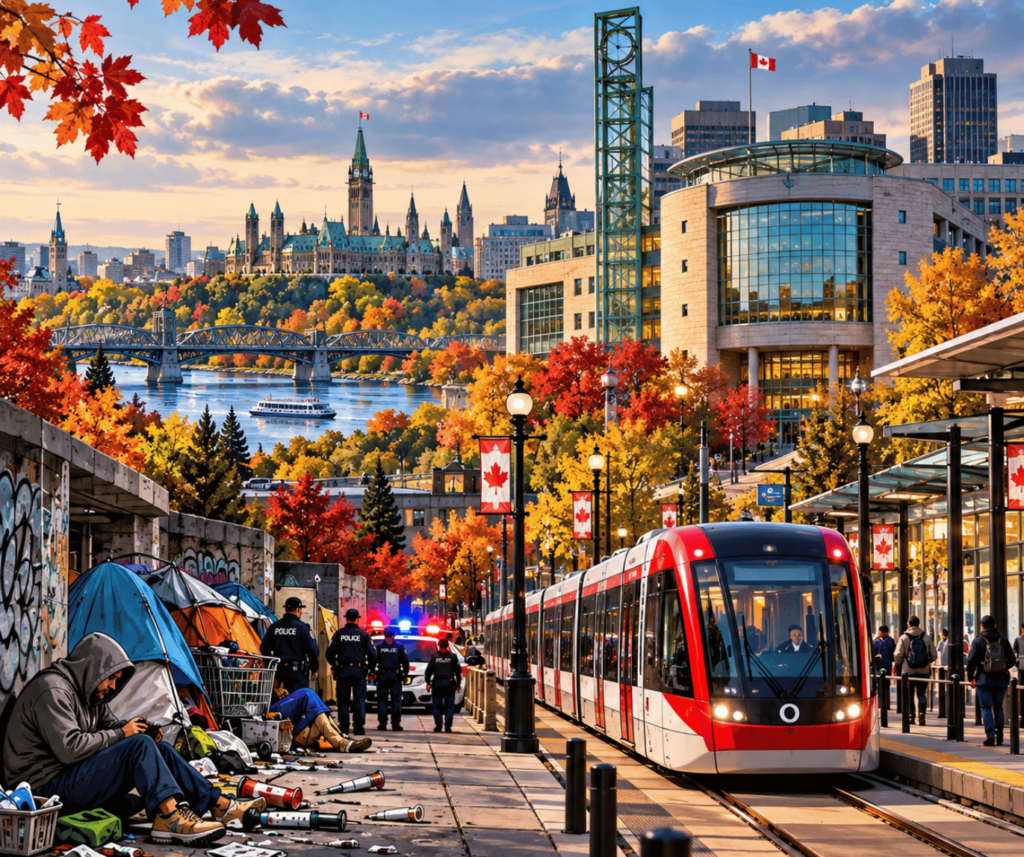
Crime and homelessness in downtown Ottawa are two of the most pressing issues in the mayoral campaign. As one long-time Ottawa resident told CBC about the situation on downtown Ottawa’s famous Rideau Street: “The guy that sits by the liquor store and shoots up dope in front of little children. Police drive by and nothing happens. That’s wrong.” (CBC article of 8 September 2016, “What do Ottawa voters want from City Hall? Here’s what they’re saying.”) 

Downtown Ottawa resident and journalist Rupa Subramanya has been a frequent critic of conditions in the city’s central core, where Parliament and many federal government offices are located. Her ongoing commentary on central Ottawa, mostly found on her X/twitter account @rupasubramanya, makes for interesting reading and provides disturbing testimony as to what is going on.

A “shameful” way to run a G-7 capital city

Subramanya has frequently criticized Sutcliffe for the “lawlessness he’s presiding over in Ottawa” noting that it was “Shameful that [Deputy Mayor Stéphanie Plante] @PlanteSteph613 @_MarkSutcliffe are in charge of running a G7 capital.” 

In August 2023, she referred to her downtown neighbourhood as “Ottawa’s Skid Row” and noted that staff at the Department of National Defense had to be relocated from a downtown office building after employees were “verbally and physical accosted.” 

On August 16, 2023, Subramanya tweeted: “My neighbourhood Rexall in downtown Ottawa is closing. The owner can’t keep up with weekly thefts amounting to nearly $8,000, rent going up, and a crime and drug infested downtown core where the drug dealers and addicts have taken over. A microcosm of life in a Canadian city.”

Later, in January 2026, Subramanya noted that downtown Ottawa was “increasingly becoming unsafe and, just a block or so from Parliament it was “becoming increasingly unsafe to live in my Ottawa neighbourhood, just steps from Parliament, a shameful state of affairs for a G7 capital.” 

Drug use, public urination, knife fights

As recently as June 2026, she posted photos of a nearby homeless encampment and criticized Ottawa police, as well as Sutcliffe and city council, over what she described as a failure to enforce existing rules against disorderly behaviour and unauthorized camping. “[The] disorder in the encampment keeps growing,” she wrote. “They’ve got couches now. There’s drinking, drug use, public urination, and there was a knife fight the other day.”

Subramanya has further noted that “before the camp expanded, on the day of the knife fight, I asked an officer parked beside it why the no loitering rule wasn’t being enforced.” Subramanya says she asked an officer if she would be able to “bring a bunch of people over and camp out in the same spot and engage in disorderly behaviour” and, according to her account, the officer said “the police don’t have the resources to enforce the rule of law and that if I wanted to report the encampment, I’d have to call the police. Apparently the officer sitting in a police cruiser, next to the encampment, with a computer in front of him, wasn’t able to do that.”

I remember downtown Ottawa quite differently. During my four years as an MP, from 2011 to 2015, I lived and worked in the downtown core roughly four days a week for about eight months of the year. I found it highly walkable and felt safe walking its streets. There were certainly homeless people living on the streets, and I occasionally encountered someone asking for spare change, but the city was generally quite calm – even a bit “sleepy.” Clearly, things have deteriorated over the past 15 years, and the downtown Ottawa I knew is not the downtown Ottawa of today. 

How did this happen? And, perhaps more importantly, when? Voters need to ask: have the last four years of Mayor Sutcliffe’s mayoralty contributed to the city’s downward spiral into the level of disorder that Subramanya so vividly describes today? 

Other issues include transportation and rapid growth

There are other important issues facing Ottawa including the transportation debacle that took place under the watch of Mayor Watson and his endorsed successor, Sutcliffe.  Most spectacular among the many transportation messes is what CBC journalist Elyse Skura called “the catastrophic launch of the east-west LRT and the pandemic cratering of ridership levels” that left OC Transpo struggling to regain the trust of riders.

Then there are the challenges of rapid growth, a problem facing many of Canada’s large and medium-sized cities. As Ottawa resident Kayla Kirkbridge told the CBC in September, “The population is just growing and growing… The traffic is just becoming more and more of an issue.” (CBC, 8 September 2026).

And the latest polling suggests that transportation is not just a campaign talking point – it is Ottawa voters’ top concern. A September ElectRight poll found that 31% of respondents identified fixing public transit as the top priority for the next mayor, followed by keeping property taxes low at 17% and public safety at 14%.


Stay tuned for more on Ottawa

I plan to take a closer look at Ottawa’s transportation and growth challenges in an upcoming Municipal Watch article.