Climate Terminology and Rivalries Among the Green Left

Climate Terminology and Rivalries Among the Green Left

Last month, I published my opinion piece “Understanding the “Municipal” Green
Agenda: The Example of Ad Bans.”
The subject matter was the City of Ottawa’s March
2024 decision to pursue the outright banning of advertisements by the oil and gas
industry in the City of Ottawa facilities, such as bus shelters and hockey arenas.

The proposed advertising ban is the, ahem, dramatic “first big step” after Ottawa’s 2019
climate emergency declaration. It seems that the City of Ottawa had its hands full with
the Covid-19 emergency of 2020-23, interrupted by the Trucker Convoy emergency of
the early winter of 2022. Now, a full five years after declaring a climate crisis and a
climate emergency, Ottawa is racing toward… an advertising ban.

Maybe the climate crisis is not such an emergency after all?

How can we make sense of this? When did “climate change” become “climate crisis”
and then “climate emergency”?

Donald Trump’s Twitter history can help us shed some light on this. Trump did not
mince words in his pre-presidential career, frequently trolling the green left and their
somewhat elastic and sloppy use of terminology. Trump took delight in mocking the
green left’s multi-decade inconsistency in their doom-saying over global “cooling” (aka
the coming ice age) and then the global “warming” scare, after which they seemed to
settle on the more neutral, and far less scary “climate change.”

Trump’s Twitter-mocking of the green left on terminology was quite entertaining but it
also pointed to a deeper truth: the struggle within the green left over their strategy and
tactics, and even their more fundamental goals.

In the years before and after Trump’s famous 2013 musing about the left’s apparent
shift from “global warming” to “climate change” there was, within the green left itself, a
raging debate about the goals of their movement. Some of them were impatient and
wanted immediate action which meant pushing a “global cooling” or “global warming” –
or an even more alarmist – narrative. Others favoured a go-slow approach, determined
to steadily inculcate the broad middle of public opinion that there was indeed some sort
of climate problem, while simultaneously avoiding any sense of alarm: in other words, a
less alarmist terminology such as “climate change.”

Trump, it seems, was only half right. While it was true that the terminology was changed
for strategic purposes, it turns out that it still wasn’t working for either faction of the
green left.

Only the moderates and non-alarmists found the “climate change” position appealing.
Softly and gently, they could plod along. But the other faction pined for more radical
action and immediate activism. “Climate change” wouldn’t do and even “global
warming” became too tame for them. It was time for a crisis – a climate crisis! Enter…
climate emergency declarations! A new approach for the green extremists.

Even among the go-fast-hardliner-alarmist crowd, there later emerged rival approaches.
Who should declare the climate emergency? Some thought “big” and were set on
persuading national and regional state and provincial governments to make the climate
emergency declarations. Others pursued a more “think globally, act locally” approach
and took a bottom-up approach, focusing primarily on local activism to push local
municipal councils. In my next piece, I’ll tell you about the local angle, how, why and
where municipalities around the world came to believe that climate change had all of a
sudden become a crisis which necessitated emergency municipal declarations.

Understanding the “Municipal” Green Agenda: The Example of Ad Bans

Understanding the “Municipal” Green Agenda: The Example of Ad Bans 

The City of Ottawa voted in March of this year to consider banning fossil fuel (oil, natural gas) advertisements in city facilities. Why would they do this, I wondered.  

Banning advertisements from gas companies? What are Ottawa city councillors concerned about?  

Are they troubled about arguments that might break out in bus shelters over the ads? No, I suspect most citizens are more concerned about getting to work on time.  

So, who does care enough about these ads to show up at a city environment and climate change committee meeting to speak out against them?  

I watched a recording of the public committee meeting online and discovered that the outrage is coming from green activists. Not the hundreds of thousands of Ottawa taxpayers, but a handful of green activists. Their agenda, as always, is to stop the use of hydrocarbons (gasoline for your car, natural gas for your home, propane for your barbecue, any hydrocarbon to generate electricity, etc.). Achieving the green agenda, at the municipal level at least, starts with a ban on oil and natural gas advertising. 

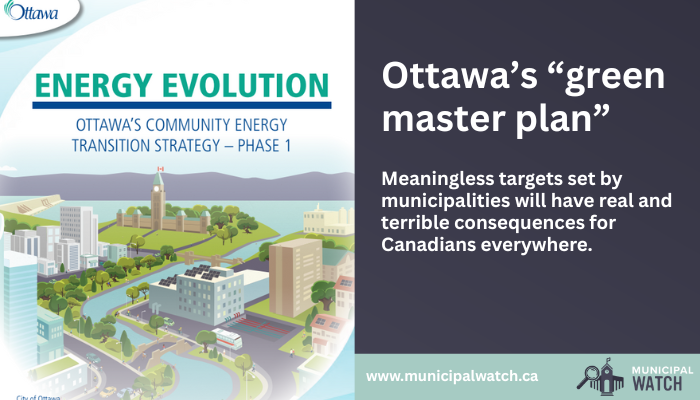
Clearly, Ottawa city councillors are listening and taking the issue seriously, and the green “narrative” very seriously. In response to the demands of the green activists, Ottawa city council declared a “climate emergency” in 2019 and, in 2020, unanimously adopted a 35-page “Climate Change Master Plan” which contained within it an 86-page implementation plan called “Energy Evolution.” The former plan, it’s important to note, included the now ubiquitous slogan, “Net Zero by 2050.” 

In the simplest terms, “net zero” – by whatever year – means that GHGs are reduced to an absolute minimum. In case there was any doubt that Ottawa city councillors were fully on board, one only needs to read the Energy Evolution implementation framework which states clearly and succinctly on page 2 that “All fossil fuels will have to be phased out.”  

It’s right there, in black and white. Ottawa city councillors mean business. It’s an emergency! 

So now, five years into the “climate emergency,”   Ottawa’s elected officials have decided to finally “take action” on their commitment to “phase out” oil and gas in Ottawa. Their first steps? Go to the people and shout “no more oil and gas” from the rooftops? Develop a detailed campaign to inform residents about the implications of taking out of common usage the fuels and technologies on which our society depends for virtually everything we do? Hold public meetings to promote the plan and invite feedback?  

None of the above. Seemingly, this is a sort of “non-urgent” emergency. 

It seems they decided to take a different approach, one that would lead to much less debate, controversy or feedback.  

They decided instead to consider a ban on advertisements promoting oil and gas usage as good for the economy.  

Why this micro-action instead of going to the people directly with the details of their ambitious plan to completely phase out fossil fuels? Surely, Ottawa residents should hear all about this. Don’t they deserve a thorough debate about the viability of this ambitious goal and a detailed roll-out of how it will be accomplished?  

Is it feasible?  

Was it ever feasible?  

How will residents be affected? When do the residents get to weigh in? Will they hear both sides?  

How can both sides of this debate be heard when Ottawa city councillors’ commitment to the democratic process is such that their first step is to ban the oil and natural gas industry from defending its existence and the merits of its product?  

Whether or not you believe that banning all fossil fuels is realistic or achievable is worthy of debate, and many (including myself) would argue that we are entering fantasyland here,  that debate won’t even get started if city councillors effectively bar the other side – i.e. anyone who disagrees with them – from making its case.  

But this is the green agenda, and, seemingly, the City of Ottawa’s agenda. It isn’t about having a public debate. It isn’t about weighing the options. It is about snuffing out one side completely. It makes one wonder what Ottawa City Council would do if they had the power to compel social media platforms like, oh, maybe X, formerly Twitter, from allowing pro-oil and gas tweets. Hmmmm! 

Municipalities for too long have gotten away with this kind of conduct. 

At Municipal Watch, we intend to shine a light on this – because it hurts us as taxpayers. It hurts us as Canadians. Instead of attending to the proper business of representing their constituents and prudently managing their cities, these local politicians are chasing green rainbows and hurting Canada. 

In my next piece, I will expose the green activists: their motives, their plan, and how they are persuading municipal councillors like the ones in Ottawa to commit to such far-reaching, ambitious and extreme goals and why the first action item they chose is a ban on advertisements.  

News Release – New Group Aims to Make City and Town Governments More Accountable

TORONTO, ON: Starting today, Canadians will have a new way to hold politicians accountable between elections. Municipal Watch is a grassroots watchdog organization that will fight back against wasteful or bad policies that only cost more and reduce quality of life in cities and towns across the country.

“We’re seeing an increasing amount of waste, inefficiency and nonsensical policies coming from municipal governments across Canada. Our goal will be to persuade cities and towns to focus on efficient service, to deliver better quality of life for everyday working taxpayers,” says Stella Ambler, President of Municipal Watch.

There are over 3,500 municipalities across Canada with more than 10,000 municipal councillors. This massive level of governance makes significant policy decisions every day that have a direct impact on the lives of all Canadians. Municipal Watch will work to amplify the voices of taxpayers across the country and hold these local governments to account.

Municipal Watch will be speaking out on issues affecting citizens at the local level such as the increasing municipal tax burden, the growing number of government employees, and costly municipal policies that simply don’t work.

“It’s time to push back on municipal governments who overtax, overspend and overregulate Canadian citizens. Municipal Watch is going to stand up and make sure that the voices of concerned citizens are heard loudly and clearly,” added Ambler.

Municipal Watch encourages Canadians to highlight examples of “municipal madness” occurring in their cities and towns across the country. The organization is already engaging citizens through its website, municipalwatch.ca. Municipal Watch will be led by Stella Ambler, a former Member of Parliament from 2011-2015.

“It will take a joint effort for this initiative to succeed,” explained Ambler. “Municipal Watch will identify examples of “municipal madness” and highlight them, while Canadians will tell us what they’re seeing on the ground, where they live. We need watchdogs everywhere to call out waste, inefficiency and nonsense so that we can work to change it.”