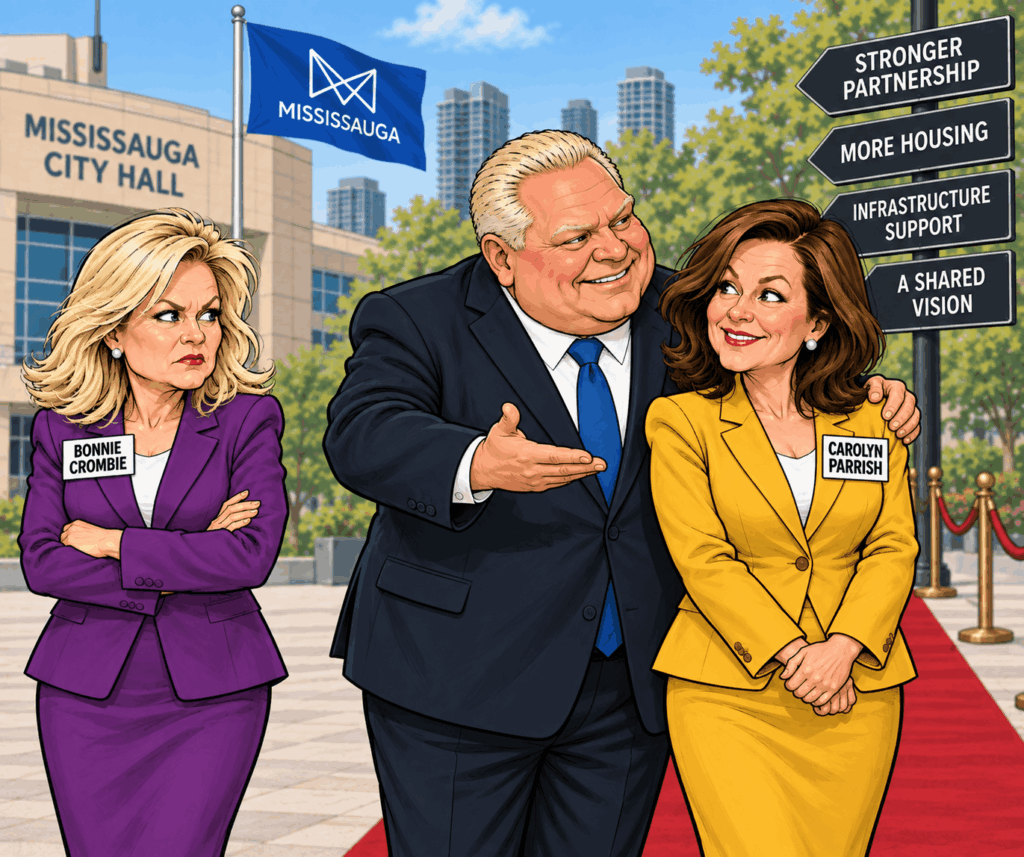
The Ford Factor in Mississauga

The Ford Factor in Mississauga

Municipalities may be creatures of the province, but should the Premier get to play kingmaker at City Hall? That’s the question worth asking as Mississauga – one of Canada’s largest cities, with roughly 770,000 residents – heads toward its mayoral election. 

Because Premier Doug Ford has made his preference pretty clear.

Ford wasn’t a fan of Bonnie Crombie even before she became Liberal leader and his opponent in the 2025 provincial election. When she was mayor of Mississauga, Crombie fought Ford’s government over development charges – the fees paid by developers to help fund the infrastructure required to service new residents. Lowering those charges prompted Crombie to ask a fairly straightforward question: if developers pay less, who makes up the difference, and do existing taxpayers end up carrying more of the cost?

Hey, Mayor! “Stop the whining and complaining!”

Ford’s response to Crombie was not exactly diplomatic. He told her to “stop the whining and complaining.”

Ford’s interaction with current Mayor Carolyn Parrish on this issue was quite different. Instead of calling her names, just last week, he (together with representatives from the federal government) handed her a cheque in the sum of up to $401.4 million for the City as part of the Development Charges Reduction Program – to pay for that infrastructure that is required and used to be paid for by development fees.

This isn’t a new alliance. In March of this year, at an announcement in Mississauga, Ford was even clearer about whom he wanted to see back in the mayor’s chair, declaring: “I will send an army down here to make sure I support Mayor Parrish.”

Ford: “I never get involved in municipal elections.”

There is something almost amusing about the sentence that preceded Ford’s militaristic declaration, which was: “I never get involved in municipal elections.” Apparently Mississauga is an exception. I doubt Crombie is shaking in her boots, however. According to a recent Liaison Strategies poll, voters were asked how Ford’s endorsement would affect their vote, and 39% said it would make them less likely to vote for Ford’s preferred candidate, while only 15% said it would make them more likely.

That’s quite a gap, and perhaps a useful reminder that a Premier’s endorsement isn’t necessarily the political gift he might imagine it to be.

And Then There Is Bill 100 (Doug Ford’s power grab)

There is a provincial issue where Crombie and Municipal Watch happen to find themselves on the same side. She and I don’t agree on very much but, on Doug Ford’s Bill 100, which I wrote about last month (https://municipalwatch.ca/2026/07/29/from-for-the-people-to-power-for-the-premier/), we do. 

Crombie has expressed opposition to the legislation, which gives the Premier the power to appoint regional chairs and then gives those appointees sweeping “strong chair” powers. The obvious concern is that a chair appointed by the Premier could potentially veto or override decisions supported by a democratically elected council.

That is a pretty extraordinary transfer of local political power to Premier Ford himself.

And it is worth noting because this is exactly the kind of issue Municipal Watch has been warning about: whatever one’s political allegiance, it is fundamentally undemocratic to give the Premier the power to appoint the leader of a regional government and then giving that Premier (Ford, and all those who come after him) enhanced powers over the elected council.

No more foreign flags at City Hall in Mississauga

Mississauga is a fascinating municipal case study because it sits at the intersection of so many of the debates currently reshaping Canadian cities. It is growing, its population is extraordinarily diverse, its housing needs are changing, its neighbourhoods are changing, and residents are clearly thinking about whether the city is headed in the right direction.

The foreign flag issue threw the curtain open on Mississauga’s changing relationship with its own multicultural identity. For years, the city has worn its diversity proudly and made cultural recognition a prominent part of civic life. But the politics surrounding some of that recognition have become considerably more complicated.

There were incidents around foreign flag raisings at Mississauga’s Celebration Square for Pakistan Day and India’s Independence Day that exposed some of the tensions beneath the city’s famously multicultural surface. Online, there were comments condemning the countries themselves as well as insults directed at residents of their respective Mississauga communities. City officials described some of the comments as “misinformed and even hateful,” while acknowledging that much of the online criticism was directed more broadly at the practice of raising foreign flags. 

No more “national colours” or “lights” either

Things became contentious enough that when Calgary City Council voted in December 2025 to end the raising of foreign national flags at City Hall, Mississauga soon followed. In April 2026, Council unanimously approved Mayor Carolyn Parrish’s call to remove national flag raisings from Mississauga’s city square. Even “displays of lights associated with national colours (with the exception of those of Canada) on the civic centre clock tower” were banned. 

The foreign flag issue also represents a striking contrast between the two frontrunner candidates. As mayor, Crombie had championed the City’s Community Recognition Program (under which the foreign flags are flown) as a way of celebrating the city’s cultural diversity; in 2026, Council headed up by Mayor Parrish passed a motion banning foreign-flag raisings, describing them as a source of “controversy and at times division within the community.” Parrish herself called the practice “very controversial” and said she was no longer prepared to continue it.

The flag controversy is interesting not because any flag, by itself, is going to determine who becomes mayor. It won’t. It is interesting because it illustrates something broader happening in Mississauga: the old assumptions about what multiculturalism looks like, and how City Hall should handle it, are running into growing pushback from residents themselves.

In addition to the debate over foreign flags, the Ridgeway Plaza controversy is another manifestation of those tensions. Arguments over development charges, density, transit and municipal autonomy are others. And now the mayoral race itself is testing whether Mississauga voters want to continue in the direction the city has been heading – or whether they are ready for a change.

That is why Canadians who don’t live in Mississauga should pay attention.

Municipal politics is where big national and provincial arguments eventually become local and very personal. Immigration, for example, eventually becomes a question about how a neighbourhood changes. Multiculturalism becomes a question about how public space is used. Housing policy becomes a question about whether you can still afford your home. Provincial power becomes a question about who gets to make decisions at City Hall. And “safety” stops being an abstract campaign talking point and becomes a question about whether residents feel comfortable walking down their own street at night.

Mississauga’s voters will decide which version of their city they want. The rest of us can learn something by watching what they decide, because the issues playing out there aren’t particularly unique to Mississauga. They’re showing up in cities across the country, in different forms and with different political personalities attached to them.

What Kind of Change do Mississauga Voters Want?

And perhaps that’s what makes this race so interesting. The question isn’t simply who will win. It is what, exactly, are Mississauga voters trying to change? And what do they think needs to be preserved?

Because when 46% of residents say their city is moving in the wrong direction, and 45% say it is less safe than it was a year ago, there is clearly a story here.
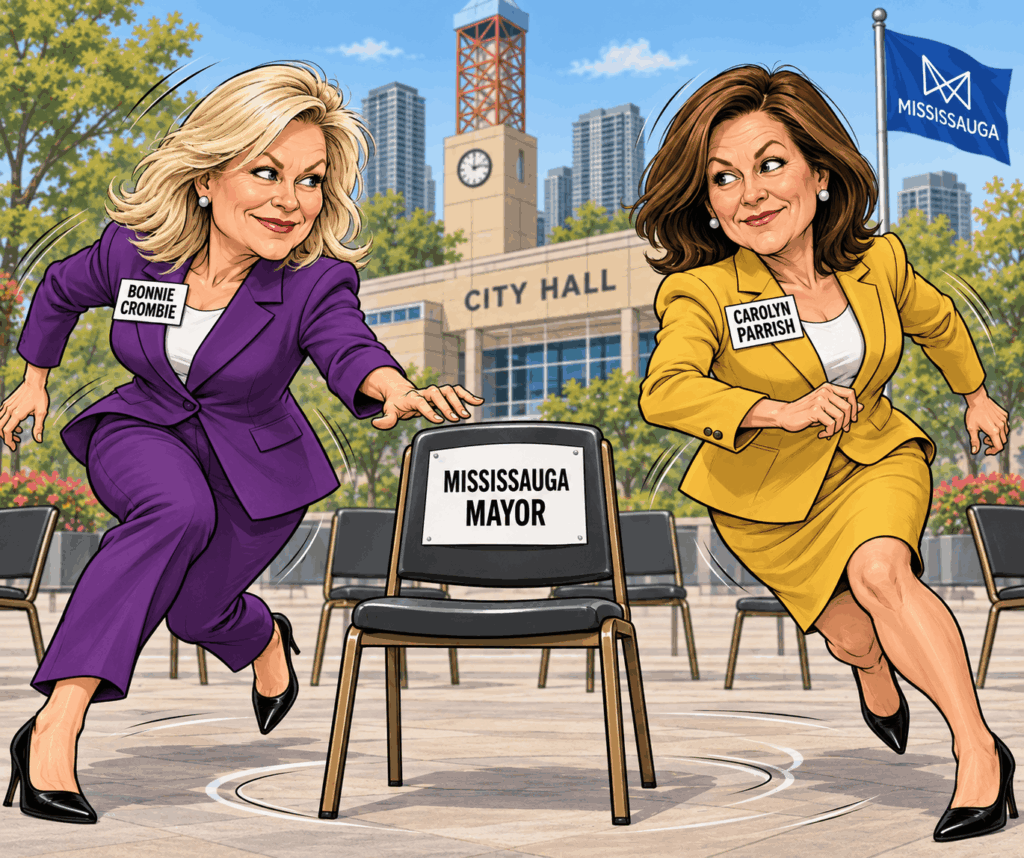
Mississauga’s Mayoral Musical Chairs

Mississauga’s Mayoral Musical Chairs

It isn’t every day that a former mayor decides to run for her old job again, especially after leaving it to pursue the leadership of a provincial political party. But that’s exactly what is happening in Mississauga.

For starters, look at the four leading contenders. Candidate A is a former federal Liberal MP. Candidate B is a former federal Liberal MP who became mayor for almost a decade and then went on to become Leader of the Ontario Liberal Party. Candidate C is a former provincial Liberal MPP, and Candidate D is a former Ontario Liberal Party candidate who later ran for the leadership of the party. Three of the four currently serve on Mississauga City Council.

Is Mississauga City Council a one-party state? Well, not technically, of course. Municipal elections are officially non-partisan, and the absence of party labels on the ballot is one of the defining features of Ontario municipal politics. But political histories don’t magically disappear just because there isn’t a party name beside the candidate’s name.

And the political landscape in Mississauga is actually rather interesting. All six federal ridings are represented by Liberal MPs, while all six provincial ridings are represented by Progressive Conservative MPPs. So no, Mississauga is hardly a one-party city. But given that rather dramatic federal-provincial political split, it is certainly curious that the four leading mayoral contenders all come from the Liberal political orbit.

I can understand the absence of NDP candidates; historically, the party hasn’t fared particularly well in Mississauga. But four leading Liberal candidates? That’s worth noticing.

Can Crombie Make a Comeback?

Bonnie Crombie’s first mayoral victory in 2014 looked as though it might be a tight race. She was running against another former Liberal MP, Steve Mahoney, and the race was expected to be competitive. Then Hazel McCallion, Mississauga’s legendary former mayor and one of the most recognizable figures in the city’s history, endorsed Crombie, and the entire dynamic changed.

McCallion’s endorsement helped catapult Crombie into the mayor’s chair, winning more than 100,000 votes and 63.5% of the vote. She won again in 2018, this time with 76.7%, and then again in 2022 with an astonishing 78.5%. Huge victories.

But 2026 is a very different race. A recent Liaison Strategies poll has Crombie and current Mayor Carolyn Parrish neck and neck at 35% each among decided and leaning voters, a far cry from the margins Crombie enjoyed in her three previous mayoral campaigns.

Out of sight, out of mind is a real thing in politics. Some Mississauga voters may now see Crombie’s return as a comeback, while others may see it as something of a consolation prize after her 2025 provincial election defeat as Ontario Liberal leader – and, even more painfully, after she lost her own attempt to win a seat in the provincial legislature in Mississauga East-Cooksville.

It’s quite a predicament for Crombie, compared with where she stood when she left City Hall.

The Crombie Reinvention Machine

Crombie has had a long political career, with elected experience at the municipal, federal and provincial levels, and she certainly hasn’t been controversy-free along the way. One thing she does seem to be very good at, though, is reinventing herself at each stage of the game.

When she was mayor, from 2014 to 2024, Crombie was simultaneously pro-development, pro-density, pro-transit and strongly pro-climate action, embracing a thoroughly woke political agenda. At the same time, she opposed reductions to development charges, expressed concern about taxpayers absorbing infrastructure costs and was fiercely protective of Mississauga’s municipal autonomy. She was particularly vocal in opposing provincial interference in municipal affairs.

After nearly three years away pursuing provincial politics, Crombie is back with a very different political message.

The message now is affordability, safety, congestion relief and fiscal accountability – pretty much a checklist of the issues topping Mississauga residents’ concerns, with a made-in-Mississauga tariff plan thrown in for good measure. It includes buying Canadian and local, helping tariff-hit businesses with their taxes and promising faster City Hall approvals – another box to tick in a carefully curated campaign message.

Voters will have the opportunity to look at both the new message and the old record and decide what to make of Crombie’s latest political incarnation. 

What About Carolyn Parrish?

The other obvious question is whether Mississauga voters will take a more critical look at current mayor Carolyn Parrish this time around than they did in 2022.

Parrish won the 2022 mayoral by-election after Crombie stepped down to pursue provincial politics. She won with just 31% of the vote, in an election where turnout was a dismal little over 25%. That’s hardly an overwhelming mandate, although it was enough to put her in the mayor’s chair.

Not many voters will remember – or are even old enough to remember – the heady days of Controversial Carolyn, the MP who was anti-American before it was fashionable. In 2003, Parrish famously said, “Damn Americans, I hate those bastards!” and later stomped on a George W. Bush doll to make her point in an episode of the television show, This Hour Has 22 Minutes.

Some people might see that kind of outspokenness as a positive attribute. But then-Liberal Prime Minister Paul Martin wasn’t impressed by Parrish’s comments about him and her Liberal caucus colleagues. She was kicked out of caucus and spent her final months on Parliament Hill sitting as an Independent MP.

She wasn’t exactly apologetic about the experience. Parrish said she had “absolutely no loyalty to this [Liberal] team. None.” And, referring to her former colleagues, she said: “After what they’ve put me through and lots of my colleagues, they can all go to hell.” Of Martin, she added: “If he loses the next election and he has to resign, I wouldn’t shed a tear over it.”

That was a long time ago. Maybe she’s mellowed since then.

And Then There Are the Other Two

Also in the 2022 mayoral by-election, Alvin Tedjo came in second with 25% of the vote, while Dipika Damerla finished third with 19%. According to the recent Liaison Strategies poll, those two are now third and fourth in voter preference, with Damerla pulling ahead of Tedjo.

So there we have it: four leading candidates, all with Liberal political pedigrees, three of them currently sitting on Council, with a former mayor trying to come back, a sitting mayor trying to hang on and two current councillors trying to break through. 

Hovering over the whole thing is one rather interested provincial “conservative” Premier with plenty of Liberal options from which to choose. And Doug Ford has made his preference very clear. 

Read about this neat twist in Mississauga Mayoral Race: Part 3.

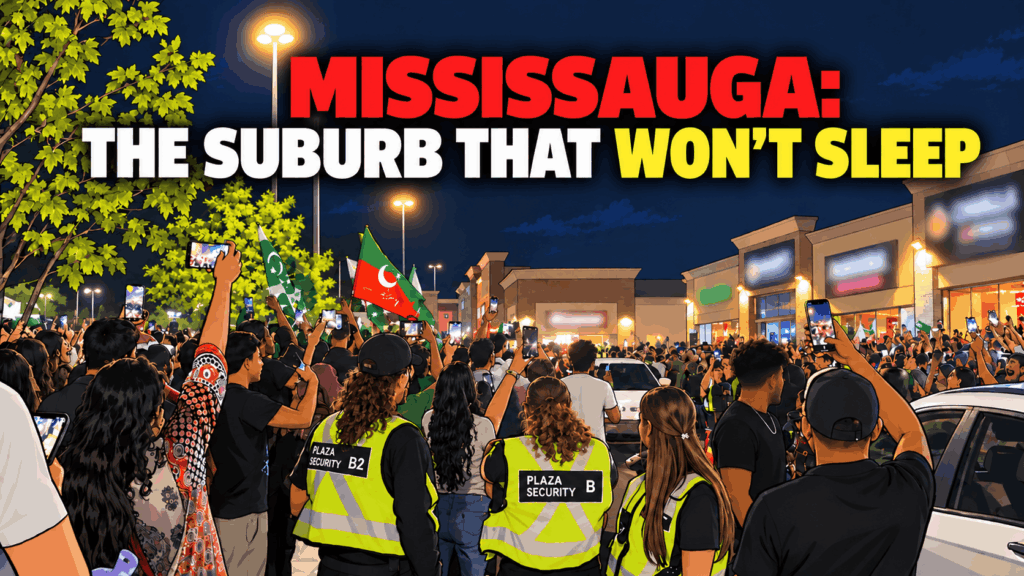
Mississauga: The Suburb that Won’t Sleep

Mississauga: The Suburb that Won’t Sleep

Something interesting is happening in Mississauga.

A recent Liaison Strategies poll found that 46% of Mississauga residents believe their city is moving in the wrong direction, compared with only 32% who think it is moving in the right direction. In politics, those are significant numbers.  People in Mississauga are not happy. Why not?

Here’s a clue: 45% said Mississauga is less safe than it was a year ago. Only 12% said it is safer, while 31% said it is about the same.

So, when half of its residents say the city is headed in the wrong direction – and nearly half say they feel less safe than they did just a year ago – it is worth asking why.

One possible piece of the puzzle is a place that has become something of a household name in Mississauga: Ridgeway Plaza.

The Ridgeway Plaza Problem

Built in 2022 in what had previously been a relatively quiet residential neighbourhood, Ridgeway Plaza quickly became a hugely popular destination. It is a collection of restaurants and shops, particularly known for halal food, and has attracted thousands of people from Mississauga and well beyond.

There is absolutely nothing unusual or problematic about that.

Mississauga is Canada’s eighth-largest city, with a population of approximately 770,000. It sits immediately west of Toronto, is slightly larger than Vancouver and slightly smaller than Winnipeg, and is home to Toronto’s major international airport. It is also one of the country’s most ethnically diverse cities.

A diverse city should have diverse restaurants, shops and gathering places. In fact, the popularity of Ridgeway is a testament to the entrepreneurial energy and cultural diversity of Mississauga.

The problem, according to a City news release, is that the plaza has also become associated with overcrowding, excessive late-night noise, illegal fireworks, illegal patios, street racing and stunt driving, physical fights and altercations, threatening and aggressive behaviour, blocked emergency access and other safety concerns.

None other than The New York Times took notice, publishing an article in March 2026 titled “The Suburb That Won’t Sleep.” The newspaper described Ridgeway as having grown to approximately 120 restaurants, primarily Middle Eastern and South Asian, and noted that it attracts thousands of diners each week.

This wildly popular commercial destination grew faster than the surrounding infrastructure and municipal rules could accommodate, however.

As The New York Times reported, the popularity of the plaza has brought noise, litter, traffic, insufficient parking, confrontations, physical fights, illegal fireworks and street racing.

Those are legitimate municipal problems that require solutions because they affect the people who live nearby.

When Cultural Celebrations Meet Neighbourhood Peace & Quiet 

There is another layer to the story, however, and this is where things get more complicated.

Certain culturally significant days have drawn particularly large crowds to the area. Unsanctioned (planned but not permitted by the city) events surrounding Pakistan and Afghanistan Independence Days, as well as National Iraqi Day, have at times attracted thousands of people.

The City itself said some of these gatherings had repeatedly created problems with its ability to maintain roads safely, control traffic, respond to emergencies and enforce municipal bylaws.

A Pakistani-Canadian physician and regular Ridgeway diner, Dr. Ilmana Fasih, offered an insightful perspective. She told The New York Times:

“I love my culture, but then I’m also critical of some of the things that we do which annoy people and which are different, because every culture has a different nuance.”

She immediately added another important point: “There are problems with us, and there are problems with racism in Canada also.”

That is probably a more useful way of looking at this than pretending that a problem doesn’t exist.

Matt Mahoney, Mississauga’s deputy mayor and the councillor whose ward includes Ridgeway Plaza, has also pushed back against the idea that the problem can simply be blamed on poor city planning. As he has pointed out, the City cannot dictate what type of businesses operate in a privately developed plaza.

Yet he has also described Ridgeway as a place that, beyond the food, has become known for “chaos.”

When the City Had to Step In

By December 2023, the problem had become serious enough that Mississauga Council, led by then-Mayor Bonnie Crombie, adopted a Nuisance Gathering By-law, which took effect January 1, 2024.

It was one of Crombie’s final acts as mayor before she resigned to seek the leadership of the Ontario Liberal Party.

The Nuisance Gathering by-law wasn’t enough.

Large unsanctioned gatherings continued. Some drew more than 3,000 people. Emergency fire routes were blocked. There were illegal fireworks, very late-night noise, street racing, stunt driving and physical altercations.

Eventually, under newly elected Mayor Carolyn Parrish, Mississauga took the extraordinary step of going to court.

The City obtained an injunction restricting nuisance gatherings at Ridgeway Plaza and giving police additional authority – and the obligation – to restrict traffic and deal with violations. The injunction specifically covered periods surrounding Pakistan Independence Day and Afghanistan Independence Day in 2025.

Seeking and obtaining a court injunction is a pretty remarkable escalation for a suburban shopping plaza that opened only a few years ago.

Chaos: A Municipal Problem in Mississauga

Mississauga is a multicultural city. Its population includes large communities from South Asia, the Middle East and many other parts of the world. People have every right to celebrate their heritage, eat the food of their home countries, gather with friends and maintain cultural traditions.

But the same rules must apply to everyone.

Celebrating your heritage doesn’t give anyone the right to block a fire route. Driving dangerously isn’t acceptable because the gathering happens to be culturally significant. Illegal fireworks don’t become legal because they are part of a celebration. And residents shouldn’t have to put up with excessive noise or unsafe streets because a particular event attracts a large crowd.

That balance is precisely what municipal government is supposed to manage.

Why Does This Matter in the Mayoral Race?

Interestingly, Ridgeway Plaza and the related controversies don’t appear to have become major issues in this year’s mayoral race – at least not yet.

Perhaps that’s because tensions have subsided somewhat following the City’s tougher approach, including the court injunction. Or perhaps none of the leading candidates wants to touch such a sensitive subject during an election campaign.

And perhaps that’s understandable, but the underlying questions haven’t disappeared.

How does a rapidly growing city accommodate new businesses and new communities without overwhelming established neighbourhoods?

How does a municipality protect cultural expression while enforcing the same rules for everyone?

And what happens when residents begin to feel that their neighbourhood is changing faster than their government can manage?

These are legitimate questions for voters to ask their local candidates. 

And that is why Ridgeway Plaza is worth watching.

Because when 46% of residents say their city is moving in the wrong direction and 45% say it is less safe than it was a year ago, politicians should probably be asking why.

Calmer, But Not Quite Settled

Since the injunction, things do appear to have improved somewhat, at least in terms of the city’s ability to control the large gatherings. The temporary court order proved effective, and in April the city and the plaza’s condo corporations reached an agreement involving cameras, gates, speed bumps, additional security and increased parking enforcement. Whether any of that has actually solved the underlying problems is another question, as the city has yet to publish meaningful before-and-after data, and complaints about traffic, noise, and safety have continued.